

A cold caller is a sales development professional who reaches out to prospects who are not expecting the call, with the goal of starting a relevant business conversation, qualifying interest, and often moving the prospect toward a meeting. In B2B, the role works best when it is tied to a defined ICP, clear qualification standards, and a phone-focused outbound process that can reliably produce qualified meetings.
If your pipeline coverage is thin, the question is not whether outbound still works. The real question is whether you have the right role, process, and expectations behind it. A cold caller can help create top-of-funnel activity, but only when the role is connected to target account selection, strong messaging, live call quality, and a clean handoff into your sales process.
Most definitions stop too early. They describe a cold caller as someone who makes unsolicited calls. That is directionally true, but incomplete for a B2B team that needs meetings booked onto the calendar, not just dial volume. In practice, a cold caller is one part of an outbound revenue engine that includes list building, research, calling, qualification, follow-up, and reporting.
This page explains the role in plain terms. You will see what a cold caller does, how the role differs from an SDR, BDR, telemarketer, and appointment setter, what skills matter most, and when it makes more sense to build in-house versus outsource.
What Is a Cold Caller?
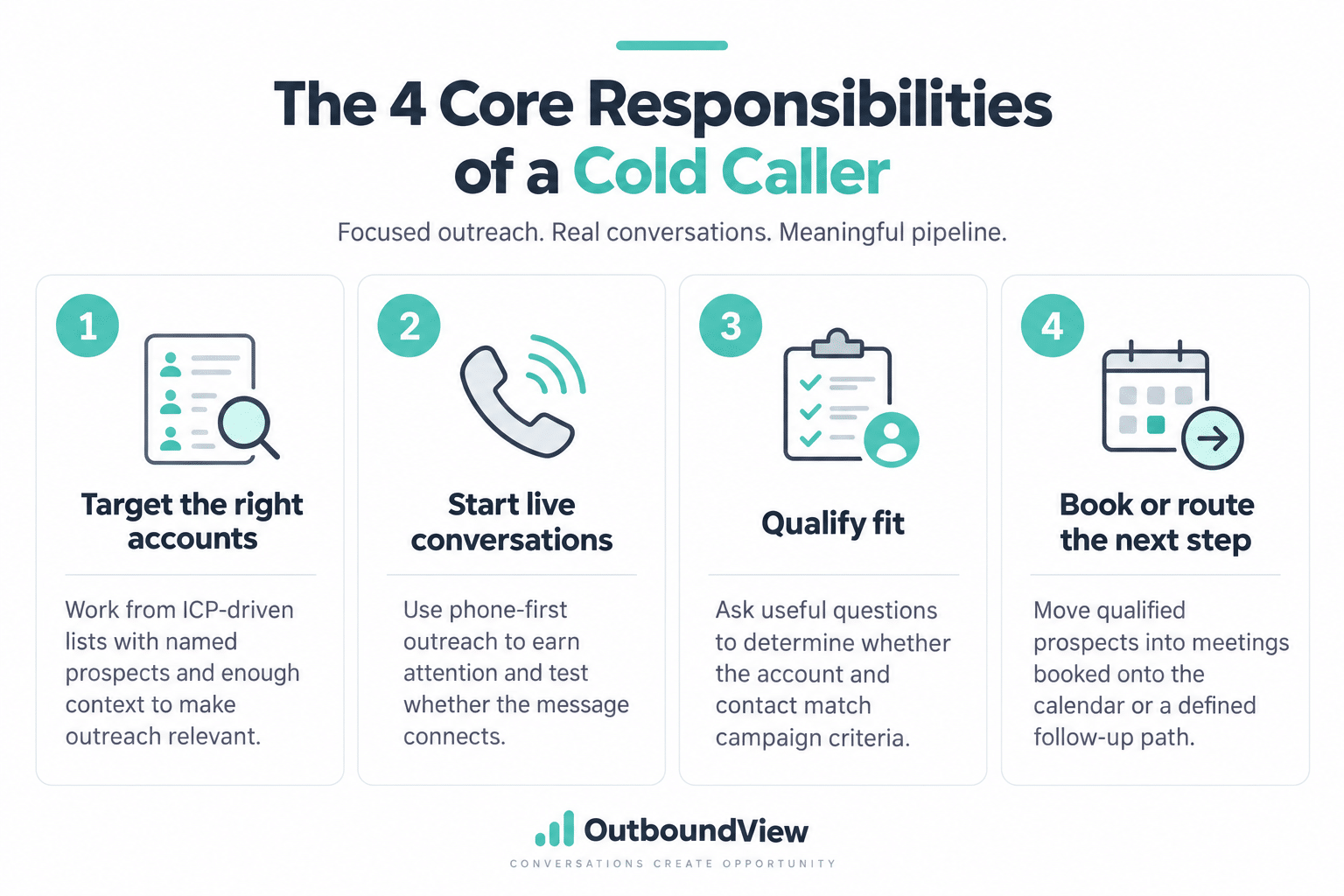
A cold caller is responsible for initiating first-touch outreach by phone. The prospect has not asked for the call and may not know your company, which means the caller has to earn attention quickly and turn interruption into relevance.
In B2B sales, the role is narrower and more disciplined than the stereotype suggests. A strong cold caller is not reading a generic script to anyone who answers. They are usually working from a target account list, calling into a defined buyer group, using a clear call objective, and trying to determine whether there is enough fit to justify a next step.
That next step matters. For some teams, a cold caller is expected to surface interest and route the lead. For others, the role includes qualification and getting qualified meetings booked onto the calendar. The title can vary by company, but the core job is the same: create productive conversations with net-new prospects by phone.
- Initiates outreach to prospects who are not expecting the call
- Works from a target list or ICP-driven account set
- Opens a business conversation and tests relevance
- Qualifies for fit, timing, or interest level
- Supports the path to a meeting or a defined next step
What Does a Cold Caller Do?
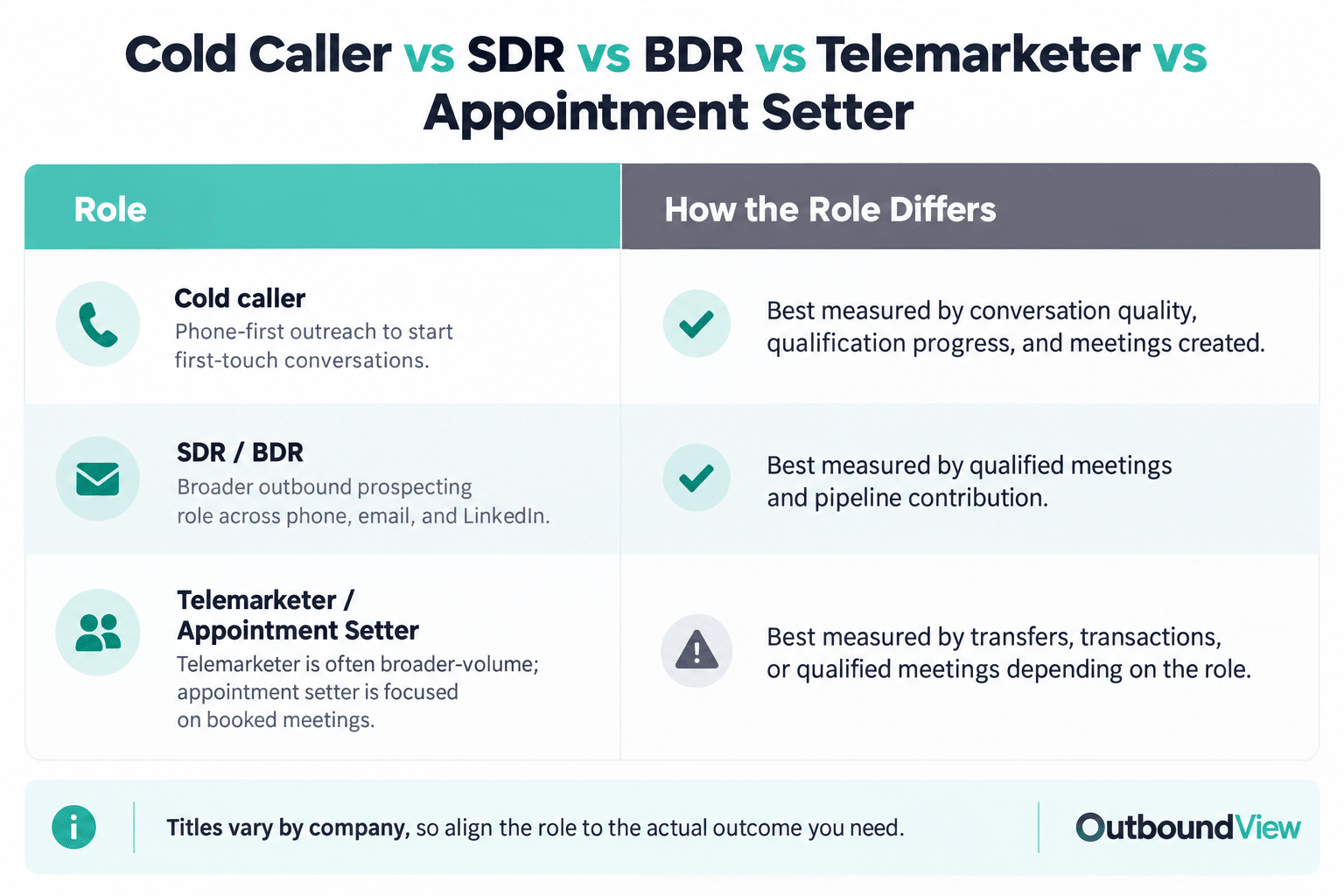
The day-to-day work is more structured than many teams expect. A cold caller does not simply dial through a list. The role sits inside a workflow that starts before the call and continues after it.
Before the call, preparation shapes results. The caller needs a usable list, the right direct dials when possible, enough account context to make the opening relevant, and clear qualification criteria. Without that foundation, call quality drops and reporting becomes hard to trust.
During the call, the job is to earn a conversation. That means getting past the first few seconds, speaking to a business problem the prospect may care about, asking a small number of useful questions, and handling objections without forcing the interaction.
After the call, execution still matters. Good cold callers log outcomes cleanly, capture notes that help the next touch, trigger the right follow-up, and hand qualified opportunities into the sales team with enough context to move forward.
- Review target accounts and contact records
- Place outbound calls into named prospects or account groups
- Use a concise opener tied to a business problem or trigger
- Ask qualification questions aligned to the campaign goal
- Book a meeting or define a next step when fit is confirmed
- Log call outcomes, notes, and objections for reporting
Cold Caller vs Cold Calling: What’s the Difference?
The cold caller is the person. Cold calling is the activity. One describes the role; the other describes the channel or tactic.
That distinction matters in planning. A company may use cold calling without having a dedicated cold caller. For example, account executives may prospect into their own territories, or a broader SDR team may include phone outreach as one part of the motion.
It also matters in performance management. If cold calling is underperforming, the issue may not be the caller alone. It could be weak targeting, low-quality data, unclear messaging, poor qualification rules, or a handoff process that makes booked meetings hard to convert.
Where a Cold Caller Fits in a B2B Sales Team
A cold caller sits near the top of the outbound funnel. The role helps move a prospect from list to live conversation and, when the process is working, from conversation to qualified meeting.
This is why the role should be measured inside a system, not in isolation. A VP of Sales usually cares less about raw activity and more about whether outbound is contributing to pipeline coverage. That means the cold caller’s work should connect to list quality, messaging, qualification, meeting acceptance, and eventual opportunity creation.
In smaller teams, one person may cover several responsibilities. In larger teams, the work is often split across list building, prospecting, qualification, and account executive handoff. Either way, the phone remains valuable because it creates direct conversations faster than waiting for email replies alone.
- Upstream inputs: ICP definition, target lists, direct contact data, messaging
- Core activity: phone-focused outreach to create live conversations
- Downstream outputs: qualified meetings, notes, handoff context, reporting
- Business outcome: stronger top-of-funnel consistency and better pipeline coverage
Cold Caller vs SDR vs BDR vs Telemarketer vs Appointment Setter
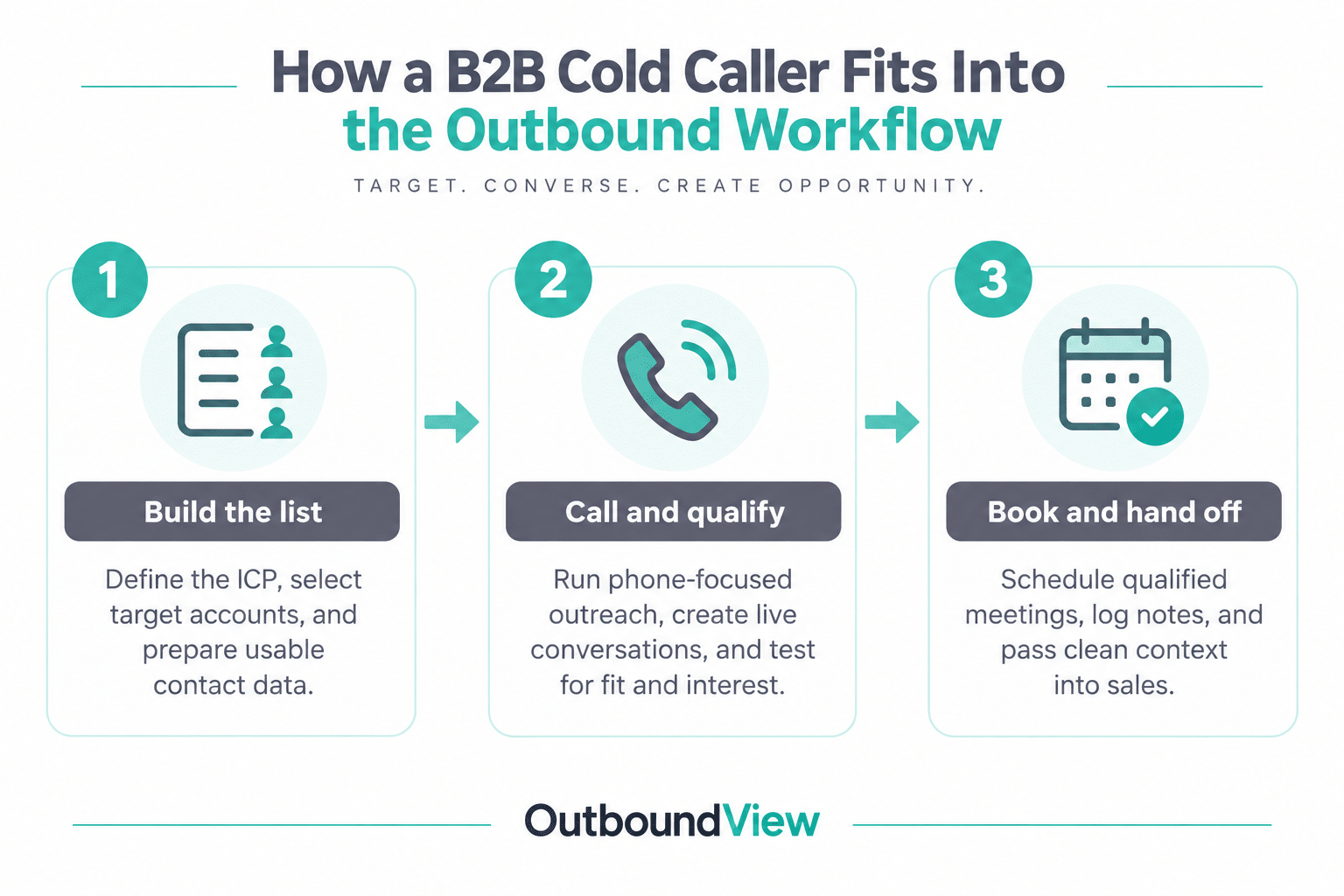
These roles overlap, but they are not interchangeable. Titles often blur across companies, which creates confusion in hiring and outsourcing decisions. The simplest way to separate them is by objective, channel mix, and what counts as success.
A cold caller is defined by phone-first outreach. An SDR or BDR may use the phone heavily, but the role usually includes email, LinkedIn, and more campaign ownership. A telemarketer is more associated with broad-volume calling and transactional outcomes. An appointment setter is closest to the revenue outcome many B2B teams want: qualified meetings booked onto the calendar.
| Role | Primary Focus | Typical Channel Mix | Success Measure |
|---|---|---|---|
| Cold caller | Start first-touch conversations by phone | Phone-first | Live conversations, qualification progress, meetings created |
| SDR | Create pipeline through outbound prospecting | Phone, email, LinkedIn | Qualified meetings and accepted opportunities |
| BDR | Develop early-stage business opportunities | Phone, email, LinkedIn | Pipeline creation and next-stage movement |
| Telemarketer | High-volume calling, often broad audience | Phone-first | Call outcomes, offers presented, transfers or transactions |
| Appointment setter | Book qualified meetings for sales | Phone-first or multichannel | Meetings booked onto the calendar with fit criteria met |
Skills Every Effective Cold Caller Needs
The best cold callers combine discipline with judgment. The role requires more than confidence on the phone. It also requires listening, message control, and the ability to work within a repeatable process.
Relevance comes before persuasion. Prospects decide quickly whether to stay on the line. A good cold caller knows how to open with context, sound prepared without over-talking, and ask questions that make the conversation useful.
Consistency separates professionals from activity-only callers. Reliable results come from call blocks, clean note-taking, objection pattern tracking, and steady improvement based on reporting.
- Clear, natural phone presence
- Fast pattern recognition and active listening
- Ability to personalize without sounding scripted
- Comfort handling objections and indifference
- Strong qualification judgment
- Clean CRM hygiene and follow-up discipline
- Coachability and willingness to iterate messaging
What Metrics Matter for a Cold Caller
Activity matters, but output matters more. If you only track dials, you can miss whether the campaign is creating real sales conversations.
The most useful view follows the path from reach to meeting quality. In B2B programs, leaders usually want to know whether the caller is reaching the right people, starting enough real conversations, qualifying appropriately, and producing meetings the sales team actually wants to take.
The exact metric names may vary by CRM or reporting stack, but the logic stays the same. Review the full chain instead of overreacting to one number.
- Connect rate: are calls reaching live prospects
- Conversation rate: are live answers turning into real discussions
- Qualification rate: are the right prospects advancing
- Meetings booked: are qualified meetings getting onto the calendar
- Meeting acceptance and show quality: does sales agree the handoff is usable
- Notes and disposition quality: can the team learn from outcomes
B2B Cold Caller Examples in Practice
The role becomes clearer when you look at real campaign structures. In each example below, the cold caller has a specific audience, a clear call objective, and a defined handoff point.
Example one: selling into operations leaders at mid-market companies. The target list is built around companies that match the ICP and named contacts in operations or revenue leadership. The call objective is to confirm whether the team is actively trying to improve top-of-funnel consistency or sales efficiency. If the fit is there, the caller books an intro meeting with the account executive and passes along notes on current process, pain point, and buying context.
Example two: selling a specialized B2B service into founder-led companies. The cold caller works from a smaller, more selective account list. The objective is not to force a long pitch. It is to determine whether the founder is still carrying too much of outbound personally and whether there is interest in handing prospecting to a dedicated team. A meeting is booked only when the pain is real and the timing is credible.
Example three: supporting a targeted appointment setting campaign. The caller reaches out to a defined buyer group, uses a qualification framework provided by sales leadership, and hands off only those prospects that match the campaign criteria. This keeps the focus on qualified meetings rather than raw volume.
Should You Hire a Cold Caller In-House or Outsource?
This is a build-vs-buy decision. The right answer depends on urgency, internal management capacity, list quality needs, and whether your team already knows how to run outbound well.
Hiring in-house gives you direct control. It may make sense if you already have messaging, management, reporting, and enough lead volume to support a dedicated role. But one cold caller without clean data, coaching, and a process often struggles to produce predictable results.
Outsourcing can make more sense when speed and structure matter. A partner can provide a phone-focused system, US-based SDRs, list support, qualification discipline, and transparent reporting. For a sales leader trying to close a pipeline gap, that can be more practical than building every piece internally before results begin.
- Choose in-house when you have strong internal management and a proven outbound motion
- Consider outsourcing when you need faster execution and tighter process support
- Evaluate whether you need only calls or a fuller prospecting program across phone, email, and LinkedIn
- Make sure qualification rules and sales handoff standards are defined either way
| Decision Area | In-House Cold Caller | Outsourced Program |
|---|---|---|
| Speed to launch | Depends on hiring, onboarding, and setup | Usually faster once ICP and messaging are aligned |
| Management burden | Owned internally | Shared with partner delivery team |
| Process maturity required | Higher if starting from scratch | Lower if partner brings structure |
| Channel coverage | May be phone only unless expanded internally | Often supports broader prospecting motion |
| Reporting visibility | Varies by internal setup | Should be defined and transparent from the start |
A cold caller is most valuable when the role is tied to a real outbound system
A cold caller can help solve a top-of-funnel problem, but the title alone does not fix pipeline. Results come from the combination of the right accounts, accurate contact data, a phone-focused outreach process, consistent qualification, and a clean handoff to sales.
If you are evaluating how to improve outbound, start by clarifying the outcome you actually want. If the goal is qualified meetings booked onto the calendar, then measure the role against that standard and decide whether you should build it internally or plug into an outsourced appointment setting model.
If you want to see how a phone-focused outbound program can support pipeline coverage, explore our approach to appointment setting at /scale/ or contact OutboundView for a conversation at /contact-us/.