

An appointment setter is a sales development resource whose job is to contact target prospects, qualify interest against basic criteria, and book qualified meetings onto a salesperson’s calendar. In practice, the role sits between prospecting and closing: the appointment setter starts conversations, confirms fit and interest, and moves qualified buyers into live sales conversations.
If your reps are closing but not prospecting enough, this is the role to look at first. When teams search for what is an appointment setter, they are usually trying to solve a pipeline problem: not enough conversations, not enough qualified meetings, and too much expensive sales time spent chasing cold outreach.
The short answer is straightforward. An appointment setter helps create top-of-funnel momentum by reaching out to prospects, handling early qualification, and getting meetings booked onto the calendar for an AE, closer, founder, or other sales owner.
Where companies get confused is role overlap. Appointment setting gets lumped together with lead generation, SDR work, BDR work, and even closing. Those functions connect, but they are not the same. The useful question is not only what the role is, but where it fits in your sales process and whether you should hire it in-house, outsource it, or solve the problem another way.
What Is an Appointment Setter in Sales?
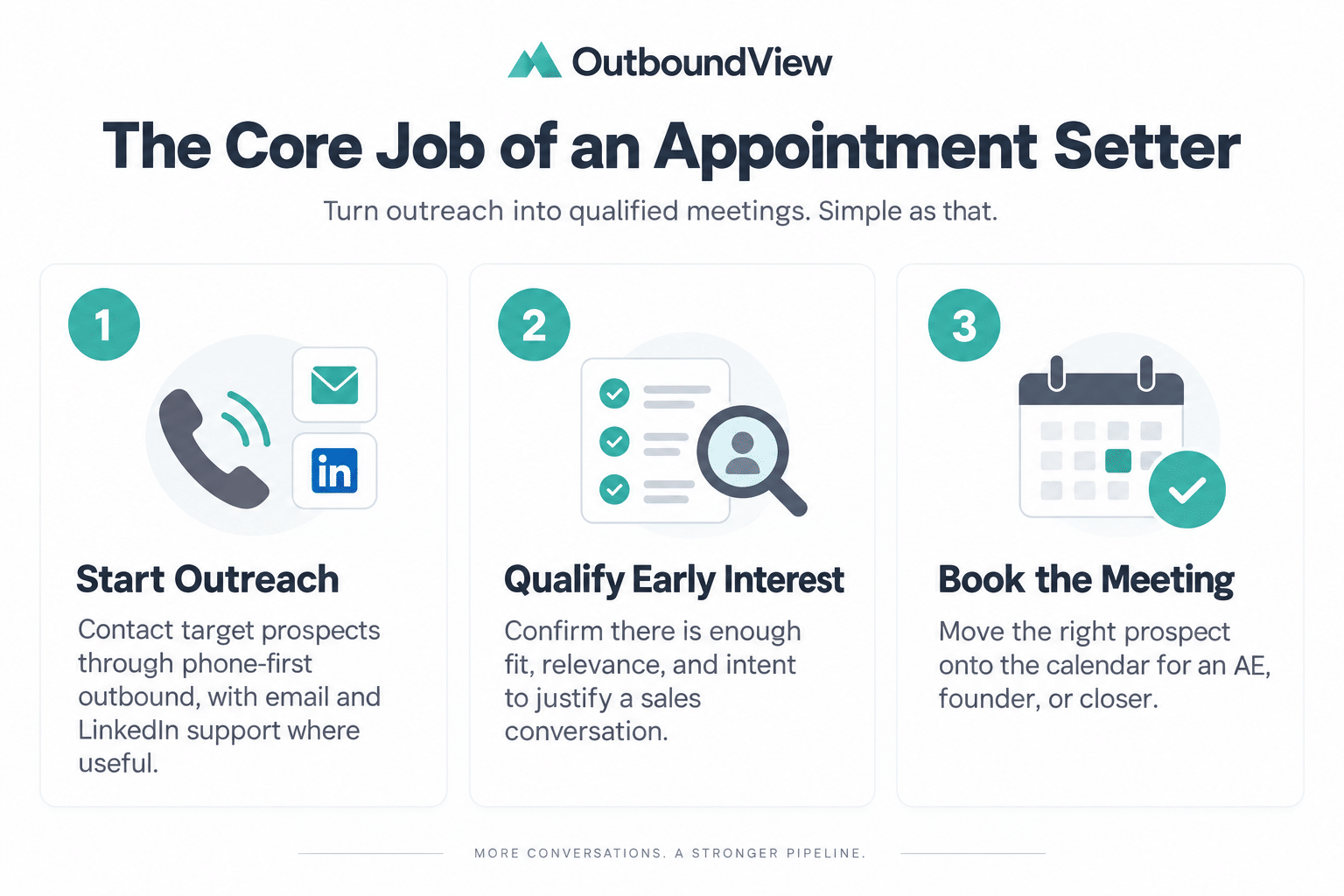
An appointment setter is responsible for turning outreach into sales conversations. The role focuses on contacting target accounts, starting dialogue, identifying whether there is a plausible fit, and moving the right prospects into scheduled meetings.
The handoff matters. A strong appointment setter does not try to run the full sales cycle. Instead, they create a clean transition from early interest to a qualified meeting, so your account executive or sales leader can focus on discovery, solution fit, and closing.
In B2B outbound, the role is often phone-first. Email and LinkedIn can support the process, but live phone conversations tend to surface intent, objections, and qualification details faster. That is one reason many companies use phone-focused teams when they need more predictable meetings booked onto the calendar.
- Identifies target prospects from an ICP or target account list
- Contacts prospects through phone, email, or LinkedIn
- Starts conversations and gauges interest
- Checks basic qualification criteria
- Books qualified meetings onto the calendar
- Confirms attendance and supports show rate
What Does an Appointment Setter Do?
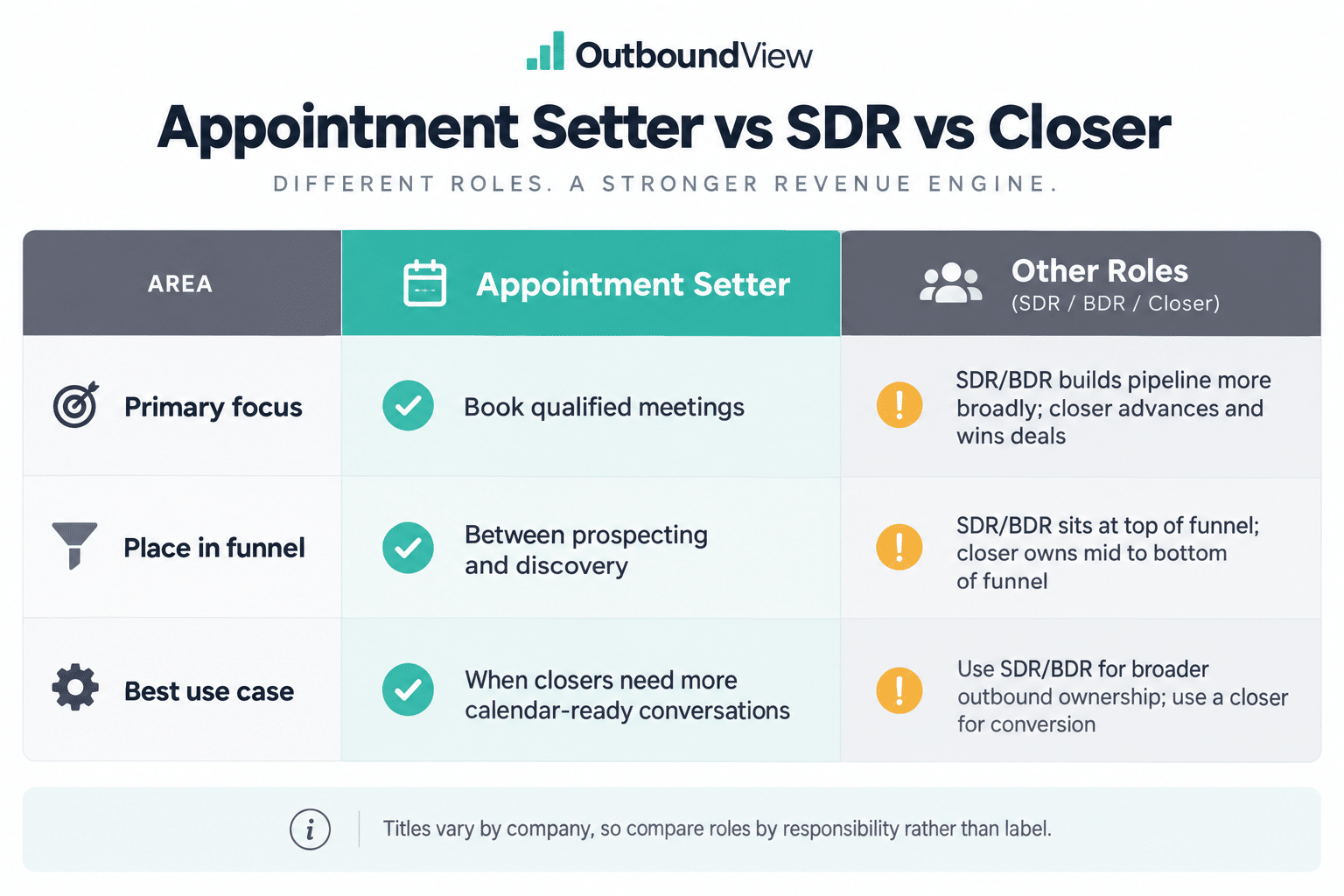
The day-to-day work is more operational than many teams assume. Appointment setting is not simply asking, "Are you free next Tuesday?" It includes list handling, outreach execution, follow-up discipline, qualification judgment, scheduling coordination, and handoff notes that help the next seller run a better meeting.
Good appointment setting follows a repeatable workflow. That workflow usually begins with an ideal customer profile, then moves into outreach, response handling, qualification, meeting scheduling, and pre-meeting confirmation.
The quality bar is simple. A booked meeting only matters if the prospect is relevant, the timing is real enough to justify a call, and the handoff gives the closer enough context to have a productive conversation.
- Review ICP criteria and target accounts
- Research the contact enough to personalize outreach where useful
- Make outbound calls and send supporting emails or LinkedIn touches
- Handle early objections and redirect the conversation toward business relevance
- Qualify for fit, pain, role, and timing at a practical level
- Book the meeting and route it to the right seller
- Log outcomes and meeting notes for reporting and follow-up
Where Appointment Setters Fit in the Sales Process
Appointment setters sit in the middle of the outbound motion. They are downstream from list building and prospect selection, but upstream from discovery, solutioning, and closing.
That placement is important for pipeline coverage. If your closers are spending too much time finding people to talk to, they have less time to run good sales conversations. If unqualified meetings are getting through, your team loses calendar capacity and confidence in outbound. The appointment setter role exists to improve that middle layer.
At a process level, think of the role as a bridge. It connects targeting and outreach to a meeting that has enough context to move the opportunity forward.
- Targeting and list building come first
- Appointment setting creates first conversations and qualification
- AEs or closers run discovery and advance the deal
- Sales leadership reviews reporting, conversion points, and pipeline created
Appointment Setter vs SDR vs BDR vs Closer
These titles overlap in the market, which creates confusion. Some companies use SDR and appointment setter almost interchangeably. Others separate them based on channel mix, qualification depth, or whether the rep owns prospecting as well as scheduling.
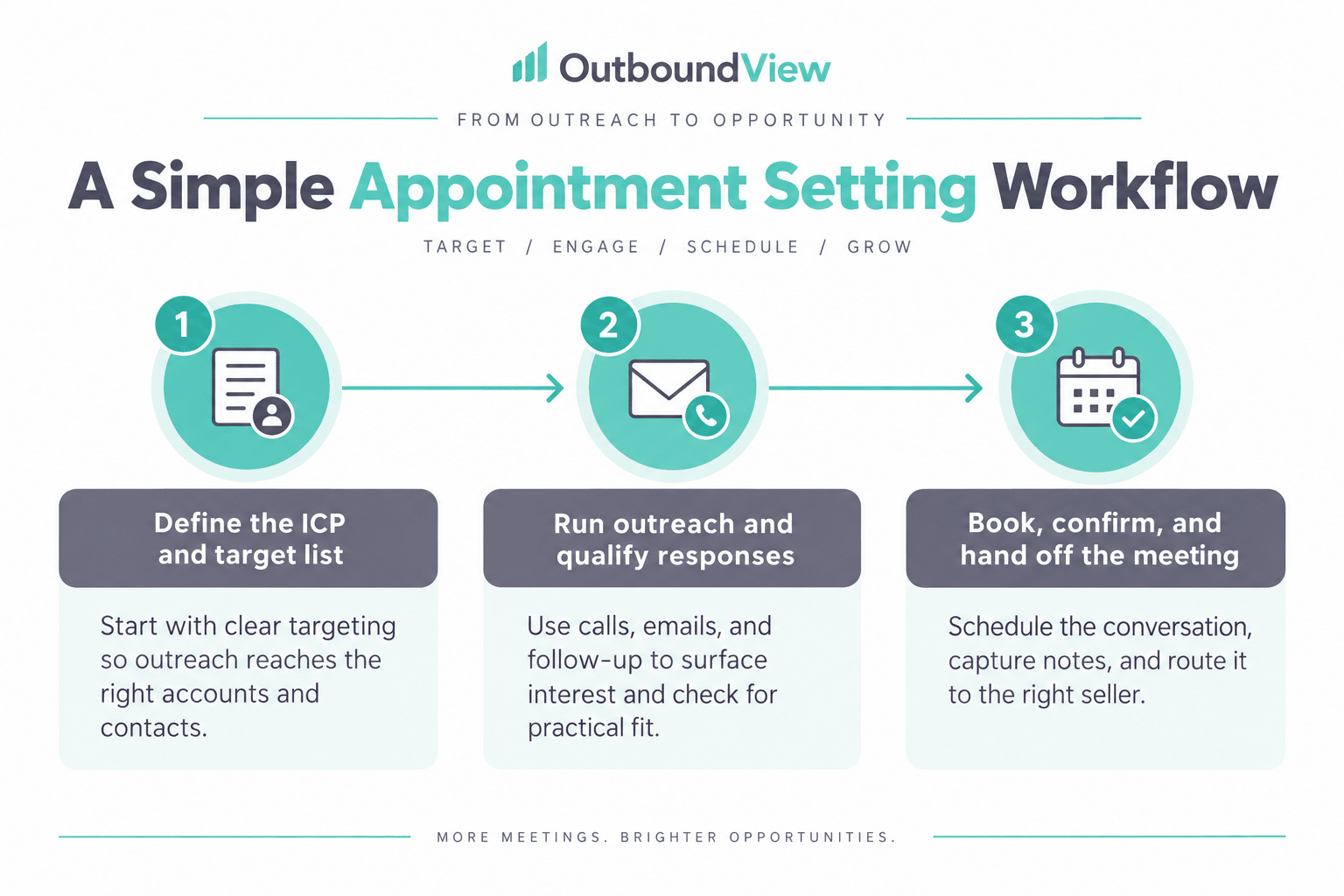
The cleanest way to think about it is by primary responsibility. An appointment setter is measured on creating qualified meetings. An SDR or BDR may do that too, but often with broader account research, multichannel prospecting, and deeper outbound ownership. A closer is responsible for moving the opportunity through the sales process and winning business.
| Appointment Setter | Start conversations, qualify at an early stage, and book qualified meetings | Between prospecting and discovery | When you need more meetings booked onto the calendar without pulling closers into cold outreach |
| SDR | Own outbound prospecting and qualification across multiple channels | Top of funnel | When you need broader pipeline creation and consistent outbound execution |
| BDR | Often similar to SDR, sometimes more account-based or territory-focused | Top of funnel | When outbound needs more strategic account coverage |
| Closer or AE | Run discovery, present solutions, and close business | Mid to bottom of funnel | When qualified opportunities need advancement and conversion |
| Virtual Assistant | Handle admin support and scheduling tasks | Support function | When the issue is coordination, not sales conversation quality |
Why Businesses Hire Appointment Setters
Most companies hire appointment setters for one reason: pipeline pressure. They need more consistent top-of-funnel activity, but they do not want expensive closers spending large parts of the week doing outbound from scratch.
The role can also improve focus. When one person or team owns outreach and meeting creation, and another owns discovery and closing, each function can get better at its specific part of the sales process.
There is also a speed benefit. A dedicated resource tends to follow up more consistently, contact more prospects, and keep calendars fuller than a team where prospecting is everyone’s side job.
- AEs are not prospecting consistently
- Founders are still doing too much outbound themselves
- Pipeline coverage is unpredictable
- Lead response and follow-up are inconsistent
- The team needs more qualified meetings, not just more leads
- Management wants clearer reporting on top-of-funnel performance
What Makes a Good Appointment Setter?
The best appointment setters combine persistence with judgment. They know how to keep outreach moving without forcing bad meetings onto the calendar.
Phone skill matters more than polished scripts. A good setter can open a conversation clearly, adapt to objections, and qualify in a way that sounds natural instead of robotic. They also know when a prospect is curious but not actually ready for a sales conversation.
Operational discipline is the other half of the role. Clean notes, calendar accuracy, smart routing, and timely follow-up all affect whether a booked meeting becomes an attended meeting and eventually pipeline.
- Clear communication on live calls
- Comfort with objections and gatekeepers
- Practical qualification judgment
- Consistency in follow-up
- Attention to CRM and calendar details
- Ability to work from a clear ICP and target list
Should You Hire an Appointment Setter In-House, Outsource, or Avoid the Role?
This is the buyer decision most pages skip. Not every company needs to hire an appointment setter, and not every pipeline problem should be solved with another headcount.
Hire in-house when the role is core, stable, and well-defined. If you already know your ICP, your message is reasonably mature, and you want this function deeply embedded with your sales team, an internal hire can make sense.
Outsource when you need speed, structure, and dedicated execution. This is often the better path when your closers need help now, your outbound process is inconsistent, or you want phone-focused activity from trained, US-based SDRs without building the function from the ground up.
Avoid hiring the role when the upstream basics are still broken. If you do not know who you are targeting, what message resonates, or who should take the meeting, appointment setting alone will not fix the issue. In that case, start with ICP clarity, target list work, and sales process alignment.
- Choose in-house if you want long-term embedded ownership
- Choose outsourced if you need faster ramp and tighter execution support
- Avoid adding the role if ICP, targeting, or handoff rules are unclear
- Review build-vs-buy based on urgency, management bandwidth, and process maturity
| Hire In-House | You have a defined process and can train and manage the role directly | Ramp time, management load, and variable execution while the process gets built |
| Outsource Appointment Setting | You need qualified meetings quickly and want a dedicated outbound motion | Requires alignment on ICP, messaging, qualification, and handoff |
| Do Not Add the Role Yet | Your targeting, offer, or sales process is still unclear | More activity may produce more noise instead of more pipeline |
How to Measure Whether Appointment Setting Is Working
Booked meetings alone do not tell the whole story. You want visibility into whether outreach is reaching the right people, whether qualification is tight enough, and whether the meetings are turning into real sales opportunities.
The most useful view is stage-by-stage. Start with contact and conversation outcomes, then look at qualification quality, show rate, and whether the meetings create pipeline your sales team can actually work.
This is where reporting discipline matters. Without clear definitions and transparent performance tracking, teams end up debating lead quality instead of improving the process.
- Contact rate
- Conversation rate
- Qualification rate
- Meetings booked onto the calendar
- Held meetings
- Pipeline created from those meetings
Appointment Setting Is a Pipeline Role, Not Just a Scheduling Task
An appointment setter helps create sales conversations that your closers can actually work. The role is most valuable when pipeline coverage is uneven, reps are not prospecting consistently, or founders and AEs are spending too much time on top-of-funnel activity.
If you are evaluating whether this role belongs on your team, start with the process. Get clear on your ICP, handoff standards, and what counts as a qualified meeting. Then decide whether to build the function in-house or buy speed and structure through an outsourced model.
If you want to see how a phone-focused team can book qualified meetings onto your calendar, explore our approach to outbound prospecting and appointment setting or contact us for a conversation.