

Sales lead generation services should help your team create qualified pipeline by identifying the right accounts, reaching decision-makers, starting real conversations, and booking qualified meetings onto the calendar. The best services do more than deliver names or lead volume. They define your ICP, build target lists, run consistent outbound prospecting, qualify interest, and report clearly on what is turning into sales opportunities.
If your pipeline feels inconsistent, sales lead generation services can close the top-of-funnel gap without pulling your AEs back into prospecting. For most B2B sales teams, the real question is not whether to generate more leads. It is whether those leads are the right buyers, reached in the right way, and qualified well enough to deserve rep time.
That is where many providers fall short. Some focus on raw contact volume. Others blur the line between marketing leads and sales-ready opportunities. OutboundView takes a sales-first approach: phone-focused outbound led by US-based SDRs, with clear qualification standards, meetings booked onto the calendar, and reporting tied to pipeline coverage.
This page breaks down what sales lead generation services should actually include, how qualification should work, when outsourced outbound makes sense, and who gets the most value from a partner built around qualified meetings rather than lead lists.
What Sales Lead Generation Services Actually Include
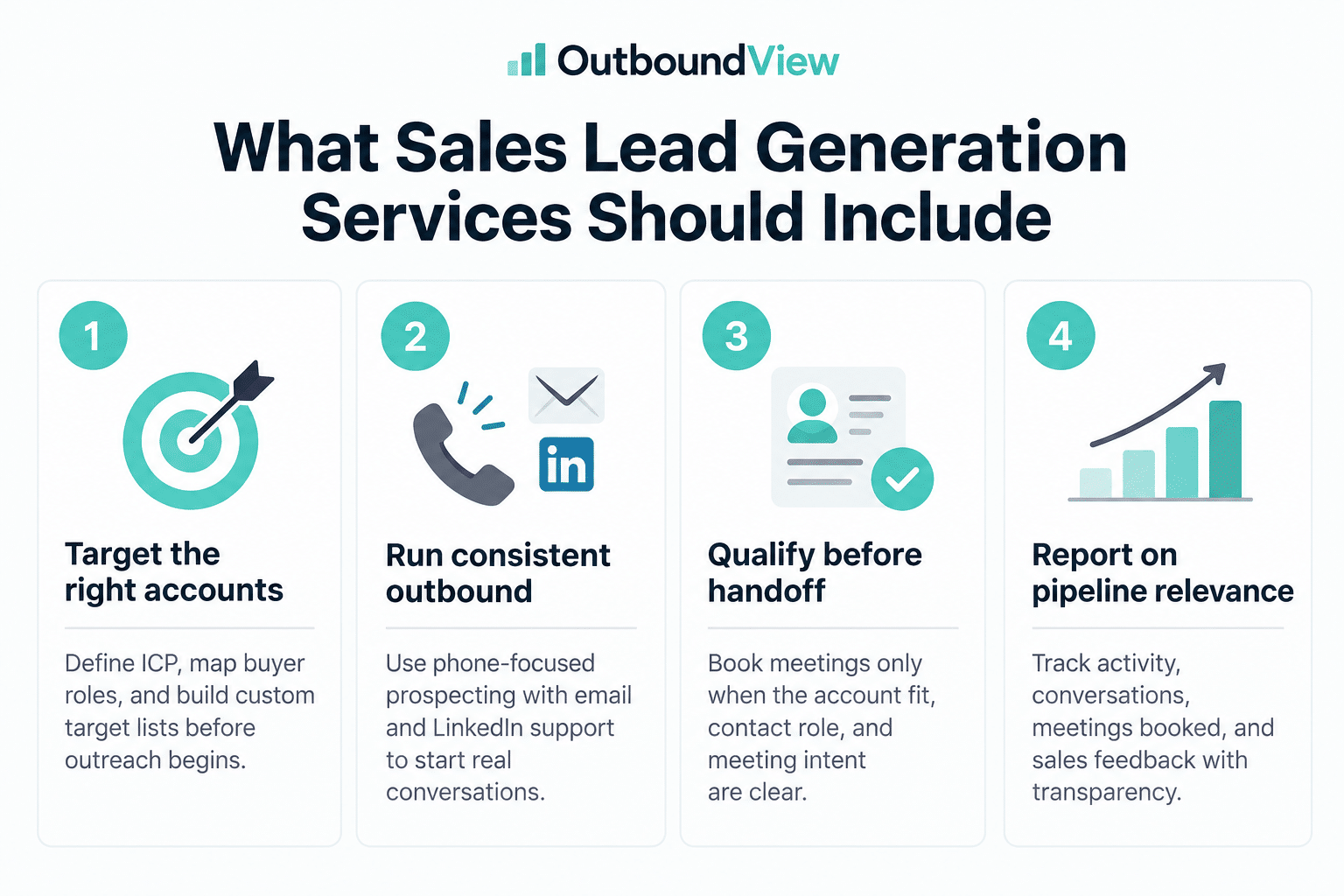
Good sales lead generation services are operational, not theoretical. You are not buying a list or a sequence template. You are buying a repeatable system that turns an ideal customer profile into conversations and qualified meetings.
At a minimum, the service should cover the full front end of outbound. That means ICP definition, target account selection, contact research, outreach execution, conversation handling, qualification, meeting booking, and transparent reporting. If a provider skips one of those steps, your internal team usually ends up filling the gap.
The clearest distinction is between sales lead generation and broader marketing lead generation. Marketing lead generation often focuses on form fills, content responses, or early-stage hand raisers. Sales lead generation is closer to pipeline creation. It targets specific accounts and contacts, engages them directly, and works toward accepted meetings that your sales team can act on.
- ICP definition and targeting criteria
- Custom target lists and contact research
- Data verification before outreach begins
- Outbound prospecting across phone, email, and LinkedIn
- Conversation handling by dedicated SDRs
- Qualification against agreed criteria
- Qualified meetings booked onto the calendar
- Campaign reporting tied to activity, meetings, and pipeline outcomes
What Makes a Lead Qualified
Lead quality is the part buyers should examine most closely. A provider can generate activity without generating useful pipeline. Qualified sales leads come from disciplined targeting and clear standards for who should be contacted, what counts as interest, and when a meeting should be handed to your team.
Qualification starts before outreach. If the ICP is loose, the titles are wrong, or the account fit is weak, the campaign may produce conversations that never convert. That is why qualification should begin with account fit, role relevance, and realistic buying context.
Qualification also needs to continue during live outreach. A booked meeting should reflect more than availability on a calendar. It should show that the prospect matches your target profile, understands the purpose of the meeting, and has enough potential value to justify AE time.
- ICP alignment: the account fits your target market, segment, and use case
- Role fit: the contact has influence, ownership, or buying relevance
- Contact validity: the data is current enough to support real outreach
- Problem relevance: the prospect can connect your offer to a business need
- Meeting intent: the buyer understands why the meeting is happening
- Disqualification rules: poor-fit accounts and contacts are screened out early
How OutboundView’s Sales Lead Generation Services Work
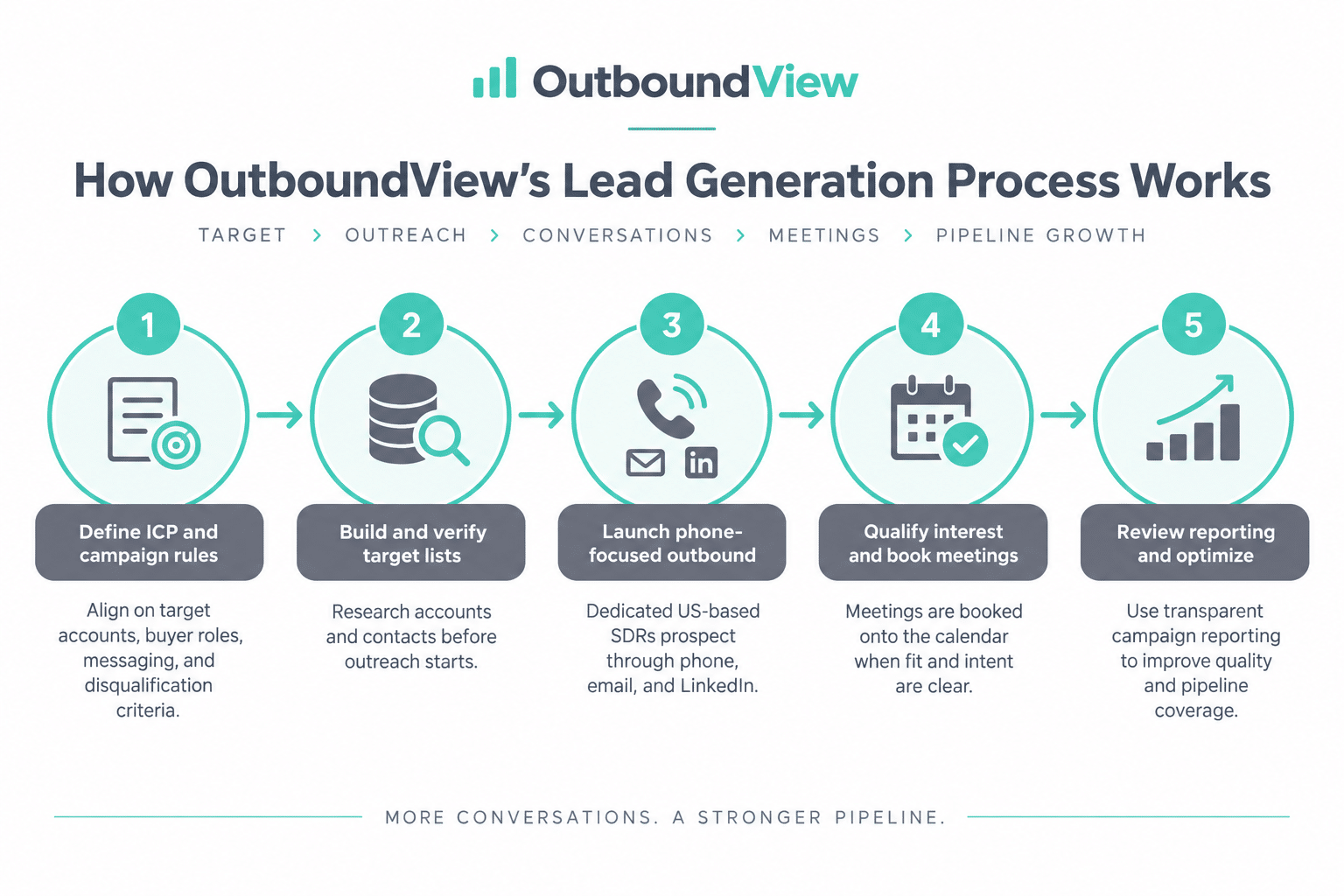
OutboundView is built for teams that need qualified pipeline, not just outreach activity. Our model combines custom targeting, phone-focused prospecting, and US-based SDR execution so your sales team can spend more time closing and less time trying to create first conversations.
We start with targeting and messaging. Before campaigns launch, we work through ICP assumptions, target account priorities, role mapping, offer positioning, and disqualification criteria. That creates the operating standard for what your SDR team should pursue and what they should leave alone.
Then we execute consistent outbound. Dedicated SDRs prospect through phone, email, and LinkedIn, with the phone at the center of the motion because direct conversation improves signal quality. When a prospect is a fit and shows legitimate interest, the SDR books the meeting onto the calendar.
Reporting stays visible. You should be able to see what is happening in the campaign, what kinds of prospects are responding, how meetings are being qualified, and where results are improving or stalling. That visibility matters if you care about pipeline coverage rather than simple activity counts.
- ICP refinement and campaign planning
- Custom target lists and contact mapping
- Phone-focused outbound with email and LinkedIn support
- Dedicated US-based SDR execution
- Qualification and meetings booked onto the calendar
- Transparent reporting and performance tracking
Who These Sales Lead Generation Services Are Best For
Outsourced sales lead generation fits best when the problem is execution capacity, consistency, or speed. Many teams know who they want to sell to, but they do not have enough SDR coverage, enough phone activity, or enough process discipline to turn that knowledge into predictable pipeline.
This is often a strong fit for VP of Sales leaders under pipeline pressure. If AEs are being asked to self-source while also carrying a quota, prospecting quality usually drops. A dedicated outbound team can restore focus by taking ownership of top-of-funnel execution.
It also works well for founder-led and lean revenue teams. Hiring, onboarding, and managing an in-house SDR function takes time. If you need meetings sooner or you are still validating the outbound motion, outsourced support can reduce build-vs-buy risk.
The common thread is not company size. It is whether you need a repeatable front-end sales motion that creates qualified meetings without distracting closers from their core job.
- Sales teams with a pipeline gap
- Organizations where reps are not prospecting consistently
- Companies expanding into new markets or segments
- Lean teams that need outbound coverage without building a full SDR department
- Revenue leaders who want clearer reporting on prospecting performance
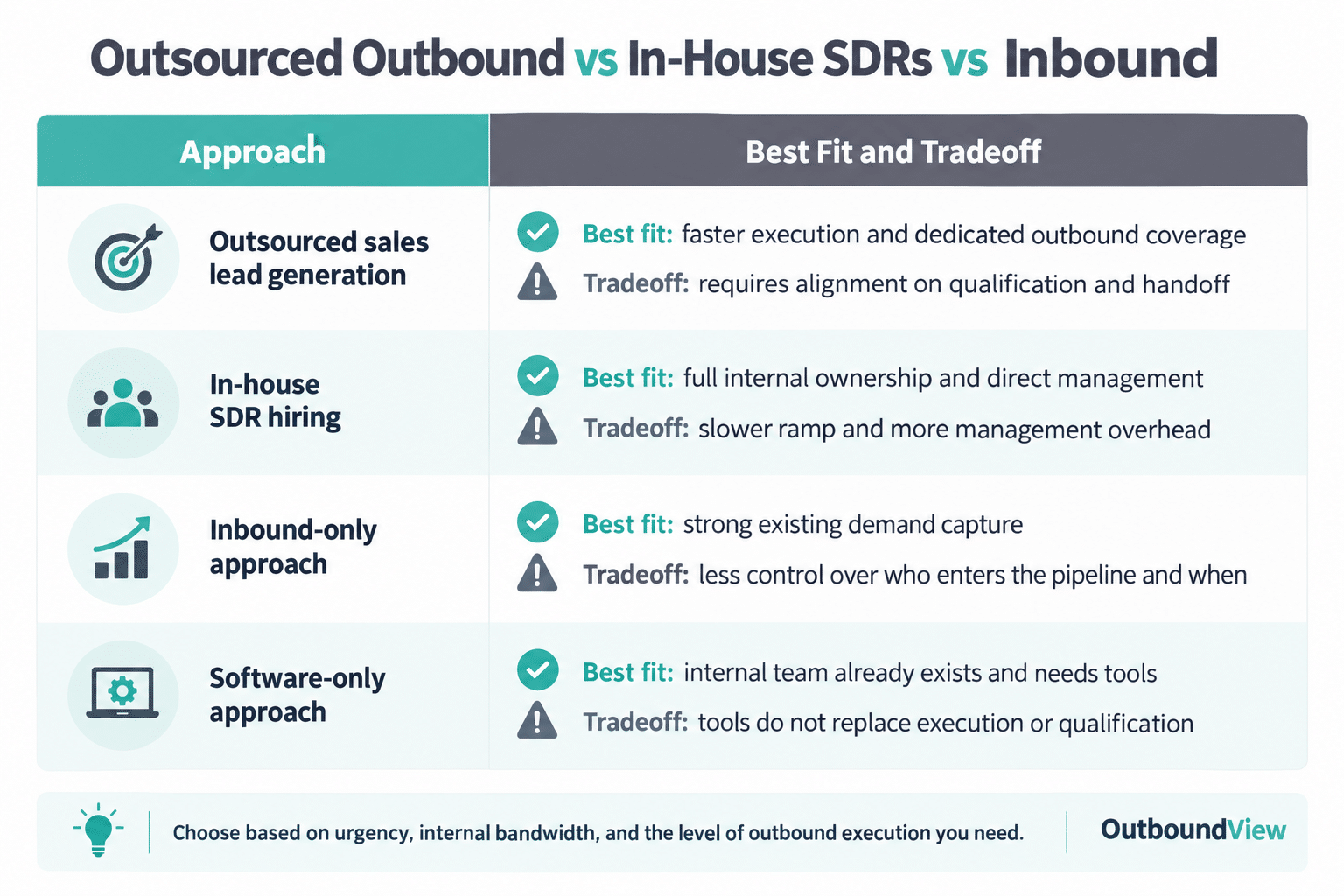
Outbound vs Inbound vs In-House SDR Hiring
Most buyers are weighing more than one path. You can build an internal SDR team, rely more heavily on inbound, add software to your current process, or work with an outsourced partner. The right choice depends on urgency, internal bandwidth, and how much process ownership you want to keep.
Inbound is valuable, but it does not solve every pipeline problem. It tends to capture existing demand. Outbound creates demand by going directly to target accounts that may never fill out a form. If your market is narrow or your sales motion depends on named accounts, outbound usually needs to play a central role.
In-house hiring gives you direct control, but it comes with ramp time and management overhead. That can make sense if outbound is already proven and you have the leadership bandwidth to recruit, train, coach, and monitor the function internally.
Software helps teams move faster, but software does not replace execution. Data tools, sequencing tools, and dialers support the motion. They do not define your ICP, improve call quality, or qualify a conversation for your sales team.
| Outsourced sales lead generation | You need faster execution, dedicated outbound coverage, and qualified meetings without building the team internally | Requires alignment on ICP, messaging, qualification, and handoff standards |
| In-house SDR hiring | You want full internal ownership and have time to recruit, train, and manage the function | Higher management load and slower ramp to steady production |
| Inbound-only approach | You already have strong demand capture and enough lead flow to support pipeline goals | Less control over who enters the pipeline and when |
| Software-only approach | You have internal people ready to execute and need better tools or workflow support | Tools improve efficiency but do not replace prospecting execution or qualification |
What to Ask Before You Choose a Sales Lead Generation Partner
Buying this service well means asking operational questions. Many vendors sound similar at a high level. The differences show up in how they define a qualified meeting, how they source target accounts, how much calling they actually do, and how they report performance.
The goal is to understand whether the provider can create accepted pipeline in your environment. That requires more than a good pitch. It requires process clarity and a realistic handoff model between their team and yours.
- How do you define a qualified meeting?
- Who owns ICP refinement and target list development?
- How is contact data verified before outreach?
- What role does the phone play in your outbound motion?
- Are SDRs dedicated or shared across clients?
- How do you handle disqualification and poor-fit leads?
- What reporting will we see regularly?
- What does your team need from our sales team to succeed?
Sales Lead Generation Services Should Be Measured by Pipeline Quality
The best evaluation standard is not lead volume. It is whether the service creates qualified meetings your team accepts and turns into real pipeline. Activity matters, but only as context for pipeline outcomes.
That is why reporting should connect execution to sales relevance. You should be able to see target coverage, outreach activity, conversations, meetings booked, meeting quality, and downstream sales feedback. If those pieces are disconnected, it becomes difficult to improve campaign performance.
For most sales leaders, the practical question is simple. Are your reps getting enough quality at-bats with the right buyers? If not, sales lead generation services should be designed to solve that problem directly.
A Better Lead Generation Service Produces Meetings Your Team Wants
Sales lead generation services are worth it when they remove prospecting burden and add qualified pipeline. That means clear targeting, disciplined outreach, strong qualification, and meetings booked onto the calendar that your sales team actually wants to take.
OutboundView is built around that standard. If you need a phone-focused partner with US-based SDRs, transparent reporting, and a process designed to improve pipeline coverage, we can help you evaluate whether outsourced outbound is the right fit.
See how our phone-focused SDR model works and schedule a discovery call: /contact-us/