

Sales outsourcing means handing part of your sales motion to an external partner, usually to build pipeline faster without hiring and managing every role in-house. In practice, the best sales outsourcing engagements focus on the top of funnel: target account research, outbound prospecting, qualification, and qualified meetings booked onto the calendar for your closers.
If your pipeline coverage is thin, sales outsourcing can help you create more top-of-funnel activity without waiting on a full internal hiring ramp. The key is knowing what to outsource, what to keep in-house, and how to manage the handoff so booked meetings actually turn into pipeline.
Most companies should not outsource every sales function. Sales outsourcing works best when you use it to support repeatable prospecting tasks, especially when your account executives are spending too much time finding leads instead of closing. It is usually less effective when a vendor is expected to own complex discovery, solution design, pricing strategy, or late-stage deal management with minimal internal support.
This guide breaks down the decision clearly. You will see how sales outsourcing works, which parts of the funnel are good candidates for outsourced ownership, where in-house teams still matter most, and how to evaluate a partner before you sign.
What Is Sales Outsourcing?
Sales outsourcing is the practice of using an outside partner to perform defined sales activities on your behalf. Depending on your needs, that can include ICP research, target list building, cold outreach, qualification, appointment setting, CRM updates, campaign reporting, or broader lead generation support.
The term covers a wide range of models. Some firms provide fractional sales leadership. Others act like a full outsourced sales team. For many B2B companies, the most practical version is an outsourced SDR function that handles outbound prospecting and books qualified meetings onto the calendar for internal sales reps.
That distinction matters. When buyers search for sales outsourcing, they are often trying to solve a pipeline problem, not replace their core sales organization. A VP of Sales usually does not need to outsource closing. They need more qualified conversations with the right accounts, better top-of-funnel consistency, and a build-vs-buy path that does not distract their internal team.
- Common outsourced functions: ICP research, list building, outbound prospecting, qualification, appointment setting, reporting
- Functions usually kept in-house: pricing, deal strategy, deep discovery, proposal creation, negotiation, closing
- Best-fit goal: create predictable pipeline without pulling closers into prospecting work
How Sales Outsourcing Works
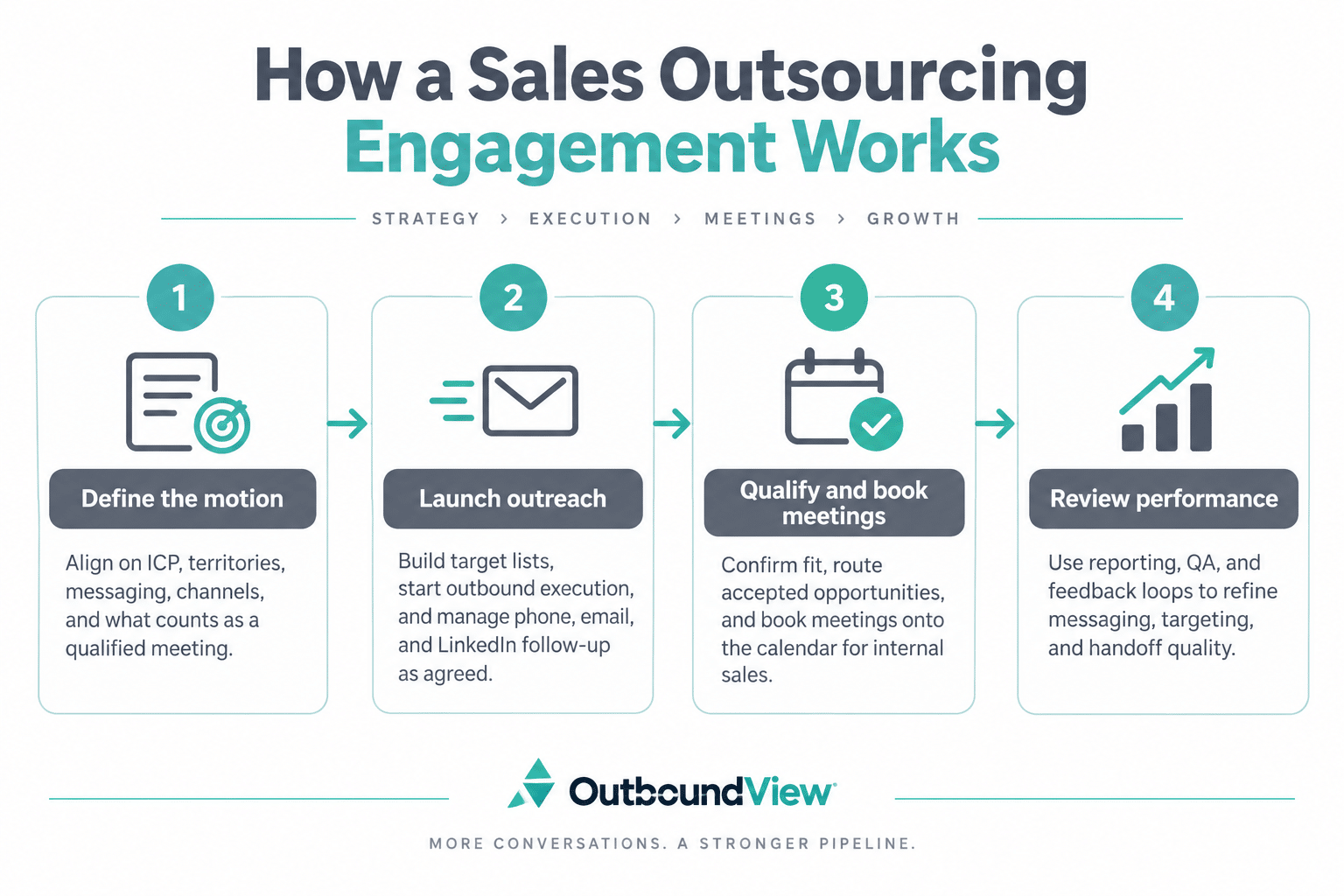
A strong sales outsourcing engagement starts with definition, not volume. Before outreach begins, both sides need alignment on your ICP, buying signals, messaging, territory, disqualification rules, and what counts as a qualified meeting.
Execution usually follows a simple operating model. The partner builds your target list, launches outreach across agreed channels, manages follow-up, qualifies interest, and hands booked meetings to your internal sales team. The better firms also provide transparent reporting, call feedback, campaign adjustments, and clear ownership of data and messaging.
Phone remains important when the goal is actual conversations. In many B2B markets, email and LinkedIn can support awareness, but phone-focused outreach is what moves prospects from passive interest to live qualification. That is especially true when your team needs meetings booked onto the calendar instead of surface-level engagement.
The handoff is where many programs succeed or fail. If qualification criteria are vague, calendars are unmanaged, or your AEs treat booked meetings like low-priority leads, performance suffers even when top-of-funnel activity is strong. Outsourcing works best when both teams share process discipline.
- Define ICP, territory, and qualification standards
- Build target lists and approved messaging
- Launch outbound across phone, email, and LinkedIn as appropriate
- Book qualified meetings and route them cleanly to sales
- Review performance, QA, and funnel outcomes regularly
What Parts of Sales Should You Outsource?
Not every part of the funnel belongs with an external partner. The most useful way to evaluate sales outsourcing is by funnel stage and task type. Repetitive, research-heavy, and outreach-heavy work is often a strong candidate for outsourced execution. High-judgment, relationship-dependent, and deal-specific work usually stays in-house.
Top-of-funnel tasks are the clearest fit. If your reps are missing quota because they are building lists, chasing cold prospects, or doing too much first-touch outreach, outsourcing can remove that bottleneck. This is where outsourced SDR teams often create the most value.
Mid-funnel support can work with the right guardrails. Qualification, meeting confirmation, basic nurture, and CRM hygiene can be outsourced when scripts, rules, and ownership are clear. But once the conversation turns into technical discovery, solution mapping, procurement navigation, or commercial negotiation, internal ownership usually produces better outcomes.
Late-stage selling rarely outsources well in B2B environments with complex sales cycles. Buyers expect continuity, product fluency, and decision-making authority. Those are harder to provide through an external team unless the engagement is unusually deep.
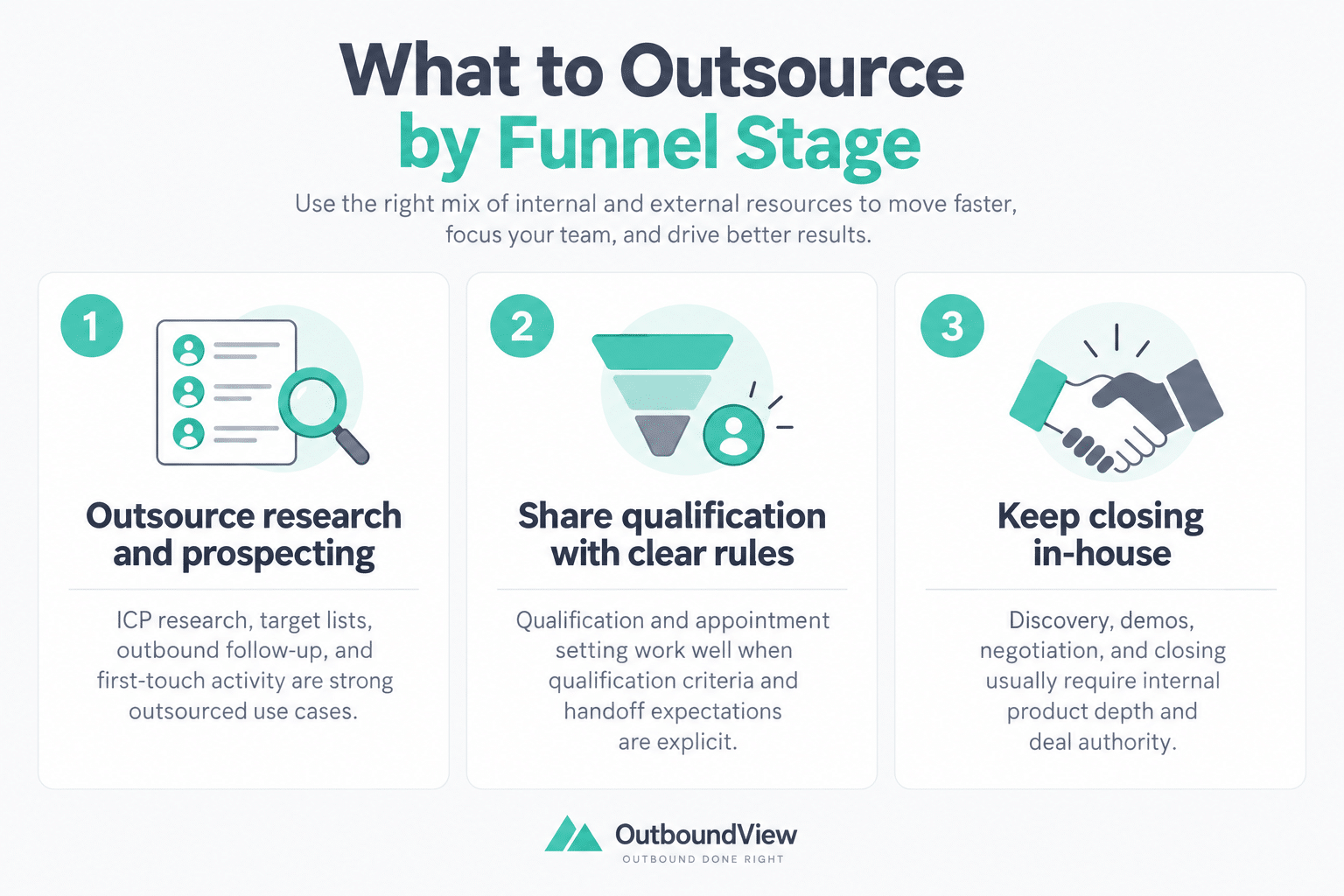
- Best to outsource: ICP research, target lists, outbound prospecting, appointment setting, early qualification
- Possible to outsource with controls: nurture follow-up, CRM updates, reporting support
- Usually keep in-house: demos, pricing, proposals, negotiation, closing, strategic account management
| Sales Function | Recommended Ownership | Why |
|---|---|---|
| ICP research and target lists | Outsourced or shared | Process-heavy work that benefits from dedicated capacity and clear criteria |
| Cold outreach and follow-up | Outsourced | Requires consistency, activity management, and multichannel execution |
| Qualification and meeting setting | Outsourced with SLA | Works well when qualification rules and handoff standards are explicit |
| Discovery and demos | In-house | Needs product depth, buyer context, and selling judgment |
| Negotiation and closing | In-house | Requires authority, trust, and deal-specific decision making |
Sales Outsourcing vs In-House Hiring
The real decision is not whether outsourcing is good or bad. It is whether outsourcing is a better fit than hiring internally for the specific gap you need to solve right now.
In-house teams offer control and institutional knowledge. You can train them deeply on your product, culture, and market. They may also become more tightly aligned with account strategy over time. But internal hiring comes with recruiting, onboarding, management load, tooling, and ramp risk.
Outsourced sales teams offer speed, structure, and specialized execution. A capable partner already has trained people, operating systems, QA, and campaign management discipline. That can make outsourced sales attractive when you need coverage quickly or when your current sales team is overloaded.
The tradeoff is control. If your offer, ICP, messaging, and internal follow-up process are not mature, outsourcing will not hide those issues. It will expose them faster. That is useful if you are ready to manage the program; it is frustrating if you expect the partner to invent your sales strategy for you.
| Decision Factor | Outsourced Sales | In-House Hiring |
|---|---|---|
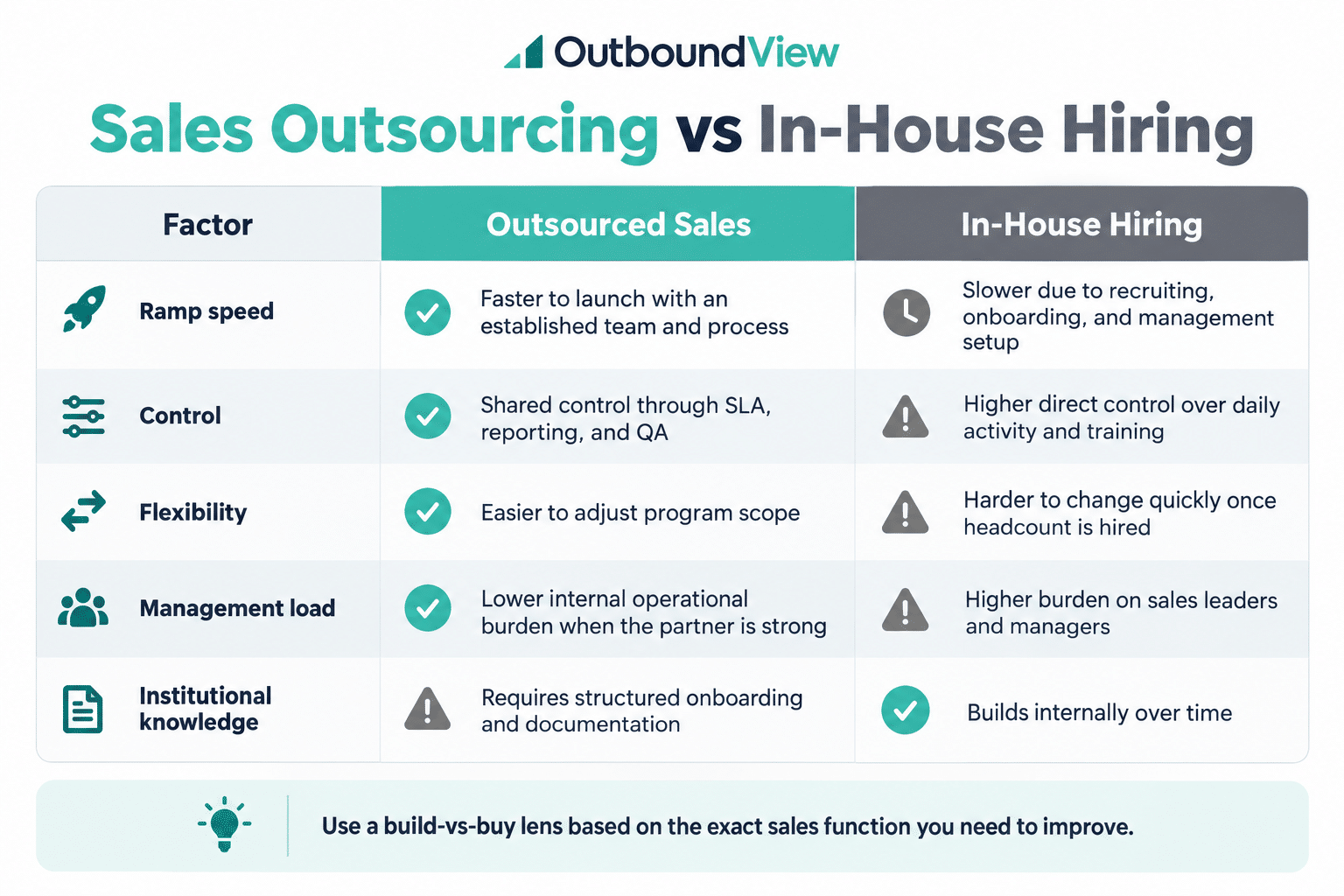
| Ramp speed | Faster to launch when the provider has an established SDR team and process | Slower due to recruiting, hiring, onboarding, and manager bandwidth |
| Control | Shared control through process, SLA, and reporting cadence | Higher direct control over training, messaging, and day-to-day activity |
| Flexibility | Easier to scale activity up or down by program scope | Harder to adjust quickly once headcount is hired |
| Management load | Lower internal operational burden if the partner is well-run | Higher burden on sales leadership and frontline managers |
| Institutional knowledge | Requires deliberate onboarding and documentation | Builds internally over time through direct immersion |
How Much Does Sales Outsourcing Cost?
Sales outsourcing cost depends on scope, not just headcount. The price structure changes based on whether you are buying list building, a dedicated SDR team, appointment setting, multichannel outbound, management oversight, or a broader lead generation program.
A cleaner way to think about cost is total operating burden. In-house hiring includes recruiting time, compensation, tooling, training, management, attrition risk, and slower time to output. Outsourcing packages those pieces differently, but the right comparison is still build-vs-buy: what does it take to create qualified meetings consistently, and how much leadership time does each path require?
The cheapest option is often the most expensive operationally. Low-cost providers may underinvest in list quality, phone coverage, QA, enablement, or reporting. That usually shows up later as weak meetings, poor show rates, unclear attribution, and frustrated AEs.
Ask for pricing context tied to deliverables and operating model. You want to understand whether the engagement includes dedicated personnel, channels used, reporting cadence, data ownership, ramp assumptions, and how quality is reviewed. That tells you far more than a flat monthly number alone.
- Evaluate scope: research, list building, outreach, qualification, reporting, management
- Compare build-vs-buy, not vendor fee vs salary alone
- Clarify whether the model is dedicated team, shared team, project, or hybrid
- Tie cost discussion to qualified meetings and pipeline coverage goals
When Sales Outsourcing Makes Sense
Sales outsourcing makes sense when the bottleneck is clear. If your account executives are spending too much time prospecting, your pipeline coverage is inconsistent, or your internal team lacks the bandwidth to open new conversations, outsourcing can be a practical solution.
It is especially useful when your company already knows who it wants to sell to. A reasonably defined ICP, a credible offer, and a sales team ready to handle qualified meetings create the conditions for outsourced prospecting to work.
The fit also improves when your need is specialized but not strategic control-heavy. For example, outsourcing appointment setting, target list building, or outbound execution is often easier than outsourcing solution selling or enterprise account ownership.
It may be a weaker fit when the product is still changing weekly, the ICP is unresolved, or no one internally owns conversion after the meeting. In those cases, the better move is often to tighten the motion before adding external volume.
- Good fit: clear ICP, defined offer, closers need more meetings, leadership wants faster top-of-funnel coverage
- Weak fit: unclear market, unstable messaging, poor follow-up discipline, unrealistic expectations about immediate results
Common Failure Modes in Sales Outsourcing
Most failed sales outsourcing programs break at the seams, not in the concept. The usual issues are poor ICP definition, weak onboarding, channel mismatch, bad handoff rules, and no shared view of what a qualified meeting means.
Another common problem is outsourcing too much judgment. If the vendor has to guess your positioning, write messaging without internal input, define qualification on the fly, and absorb product nuance through trial and error, quality drops quickly.
Governance matters more than many buyers expect. Without reporting discipline, call review, messaging feedback loops, and SLA clarity, internal teams often conclude the program is underperforming without knowing why. Good partners make performance visible enough to improve it.
Ramp expectations also need realism. Even strong programs need onboarding, testing, and iteration. The point of outsourcing is not magic. It is faster access to structured execution, experienced talent, and repeatable prospecting systems.
- Poor ICP and target list quality
- Weak onboarding and limited enablement
- No clear definition of qualified meetings
- Broken handoff from SDR to AE
- Channel mix that does not match the market
- Inadequate reporting, QA, and ownership expectations
How to Evaluate a Sales Outsourcing Partner
A good sales outsourcing partner should make the operating model easy to inspect. You should be able to understand how they build lists, how outreach is executed, how calls are reviewed, how meetings are qualified, and how results are reported.
Start with ICP alignment. If a provider cannot speak clearly about your buyer, sales cycle, product complexity, geography, and channel fit, the engagement will struggle no matter how polished the pitch sounds.
Then review governance. Ask how often performance is reviewed, what the dashboard includes, how messaging changes are handled, who owns the CRM data, and what happens when quality issues appear. Strong vendors are comfortable with transparency.
Finally, look at fit with your internal sales process. The partner can create meetings, but your team still needs to convert them. Make sure handoff standards, acceptance criteria, and follow-up expectations are explicit before launch.
- How do you define and validate ICP fit?
- What does onboarding require from our team?
- Which channels do you use, and when is phone the primary motion?
- How do you define a qualified meeting?
- What reporting will we see each week or month?
- Who owns the data, messaging, and campaign learnings?
- How is call quality reviewed and improved?
- What does the handoff to our sales team look like?
Sales Outsourcing Works Best When You Outsource the Right Things
Sales outsourcing is most effective when it solves a specific pipeline problem. For most B2B teams, that means outsourcing research, outbound prospecting, and appointment setting so internal sellers can focus on discovery, deal progression, and closing.
The best decision is rarely all-in or all-out. It is a practical division of labor: outsource repeatable top-of-funnel execution, keep high-judgment selling in-house, and manage the program with clear qualification standards, reporting, and handoff discipline.
If you are evaluating build-vs-buy right now, use that lens first. Decide which sales tasks are slowing your team down, which ones require internal ownership, and whether an outsourced SDR model could create qualified meetings without adding management drag.
If you want to see how a phone-focused, US-based SDR team can support qualified meetings and stronger pipeline coverage, explore our approach to outsourced prospecting at /scale/ or Schedule a Discovery Call at /contact-us/.