

An appointment setter is the person or team responsible for starting outbound conversations, qualifying early interest, and booking qualified meetings onto your sales team’s calendar. For buyers evaluating support, the real question is less about the job title and more about whether appointment setting can reliably improve pipeline coverage without forcing closers to spend their week prospecting.
If your reps are carrying quota and still expected to prospect, pipeline usually suffers. An appointment setter helps by taking on the front end of outbound: identifying the right accounts, reaching out across phone, email, and LinkedIn, qualifying fit and interest, and getting meetings booked onto the calendar for account executives or closers.
For most B2B teams, the value of an appointment setter is focus. Your sales team can spend more time running discovery, advancing opportunities, and closing deals while a dedicated prospecting function works the top of funnel consistently.
That said, not every company needs the same version of appointment setting. Sometimes you need one internal hire. Sometimes you need a broader SDR function. And sometimes the faster path is outsourced appointment setting with a phone-focused, US-based SDR team that can launch without the build-vs-buy delay.
What Is an Appointment Setter?
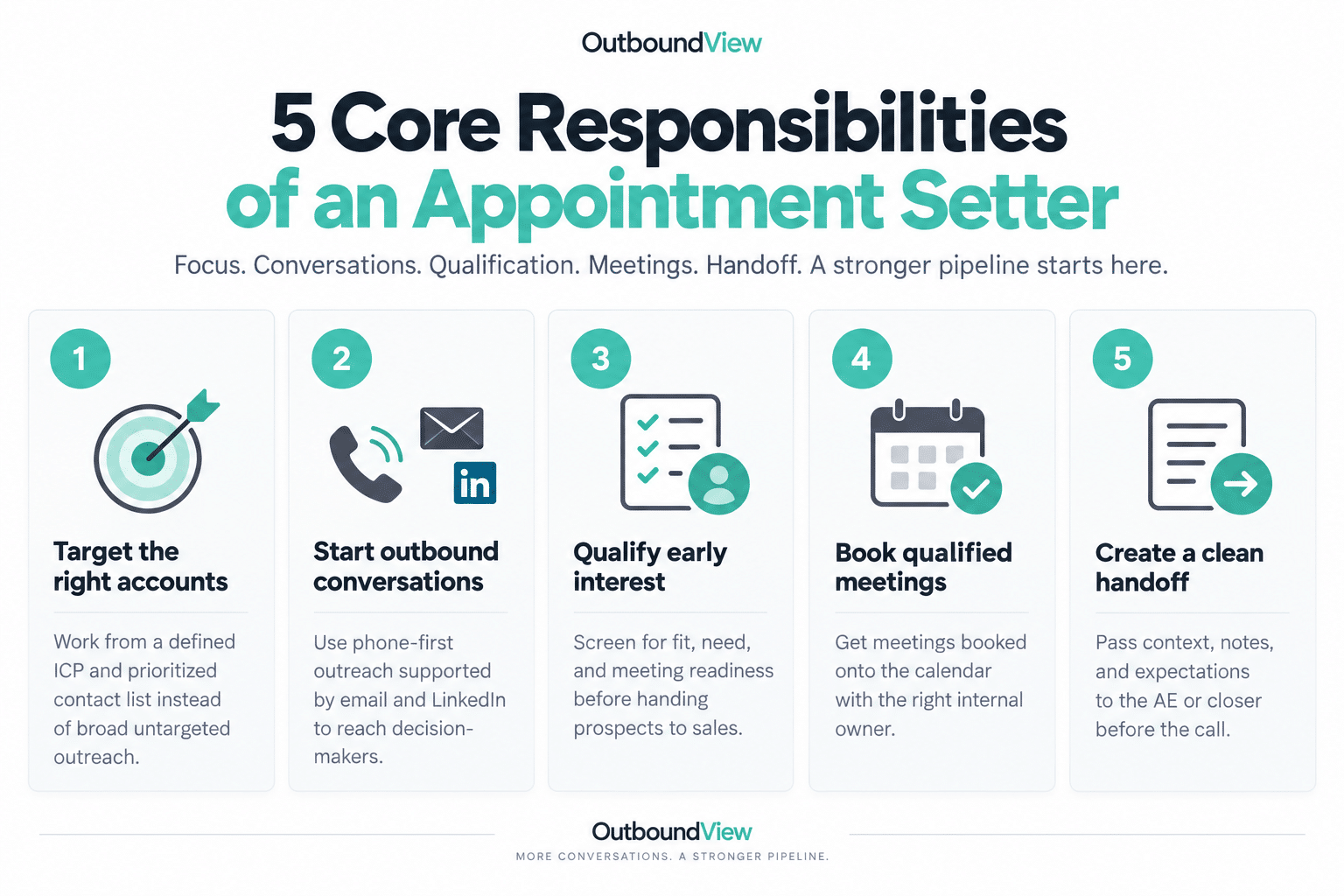
An appointment setter is a front-end sales resource. Their job is to create sales conversations with the right prospects and move qualified contacts into scheduled meetings with your team.
In practice, appointment setting sits between list building and closing. The role is usually responsible for outreach, follow-up, initial qualification, calendar coordination, and clean handoff. In many B2B organizations, the title overlaps with SDR or BDR, but the functional goal is specific: booked meetings with people who fit your ideal customer profile.
For buyer-side evaluation, outcomes matter more than titles. If someone calls themselves an appointment setter but does not work a clear ICP, qualify basic fit, or hand off cleanly to sales, they are not solving the pipeline problem you actually have.
- Prospect into target accounts
- Start conversations through outbound channels
- Qualify for fit, need, and meeting readiness
- Book meetings onto the calendar
- Prepare the AE or closer with context before the call
What Does an Appointment Setter Do Day to Day?
The day-to-day work is more operational than many buyers expect. Good appointment setting is not random cold outreach. It is a structured process tied to targeting, messaging, follow-up discipline, and qualification standards.
Phone work is usually the highest-signal activity. In complex B2B sales, live conversations help teams learn faster, qualify faster, and uncover objections earlier than email alone. That is why many companies prefer a phone-focused model instead of relying on passive inbox activity.
- Review target accounts and contact lists
- Prioritize outreach by ICP fit, market segment, and campaign goals
- Call prospects and leave relevant voicemails where appropriate
- Send follow-up emails tied to the conversation or value proposition
- Use LinkedIn to support visibility and follow-up
- Handle responses and screen for baseline qualification
- Coordinate meeting times and confirm attendance
- Document activity, outcomes, and handoff notes in the CRM
What an Appointment Setter Is Not
A lot of confusion comes from role overlap. Buyers often use appointment setter, SDR, BDR, telemarketer, virtual assistant, and closer interchangeably. That makes it harder to evaluate the right support model.
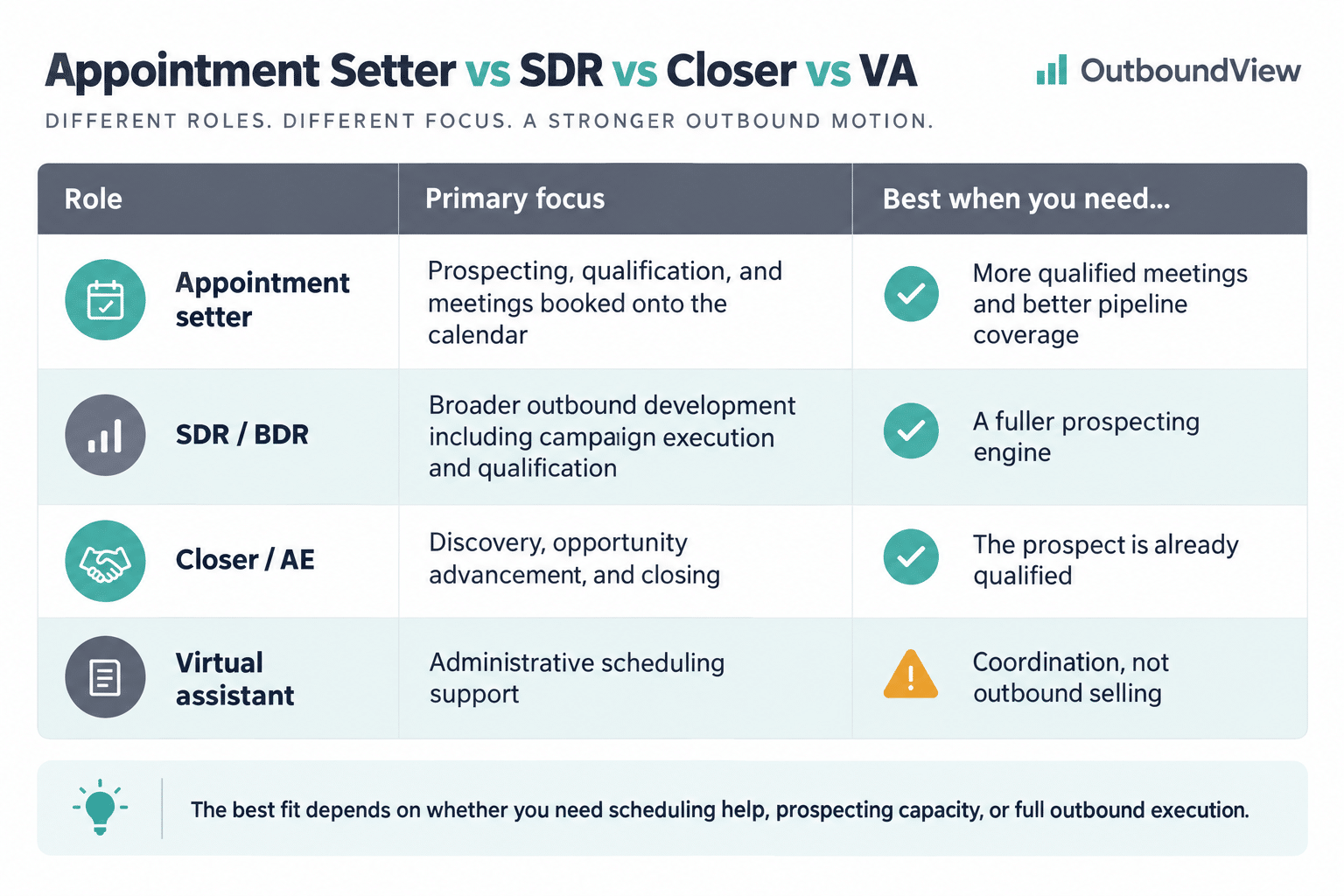
The simplest way to think about it is by primary responsibility. Appointment setting is focused on creating qualified sales conversations. Other roles may touch that process, but they are accountable for different outcomes.
| Appointment setter | Prospecting, qualification, and meetings booked onto the calendar | When you need more qualified meetings and better top-of-funnel consistency |
| SDR / BDR | Broader outbound development function that may include research, sequencing, qualification, and pipeline creation | When you need a more complete prospecting motion, not only meeting booking |
| Closer / AE | Discovery, solution fit, opportunity advancement, and closing | When the conversation is already qualified and sales-ready |
| Virtual assistant | Administrative support and coordination | When you need scheduling help, not outbound selling |
| Telemarketer | High-volume calling, often with limited qualification depth | When the goal is broad reach rather than nuanced B2B qualification |
Appointment Setter vs SDR: Does the Difference Matter?
Yes, it matters if you are buying for outcomes. Some teams want a narrow function that simply produces booked meetings. Others need a more complete SDR motion that includes list development, messaging refinement, multi-channel outreach, qualification standards, reporting, and campaign management.
In outsourced models, the distinction matters even more. If a vendor sells ‘appointment setters’ but expects you to provide the list, the messaging, the tech stack, and the management layer, you are still carrying much of the prospecting burden internally.
For most VP of Sales buyers, the better question is this: do you need a person who schedules meetings, or a dedicated outbound system that consistently creates qualified meetings? OutboundView’s approach is built around the second option.
- Choose a narrow appointment setter model when your strategy, list quality, messaging, and management are already in place
- Choose a broader SDR model when you need execution plus campaign infrastructure
- Use build-vs-buy thinking to decide whether speed, oversight, and ramp risk point toward outsourcing
How Appointment Setting Works in an Outbound Sales Process
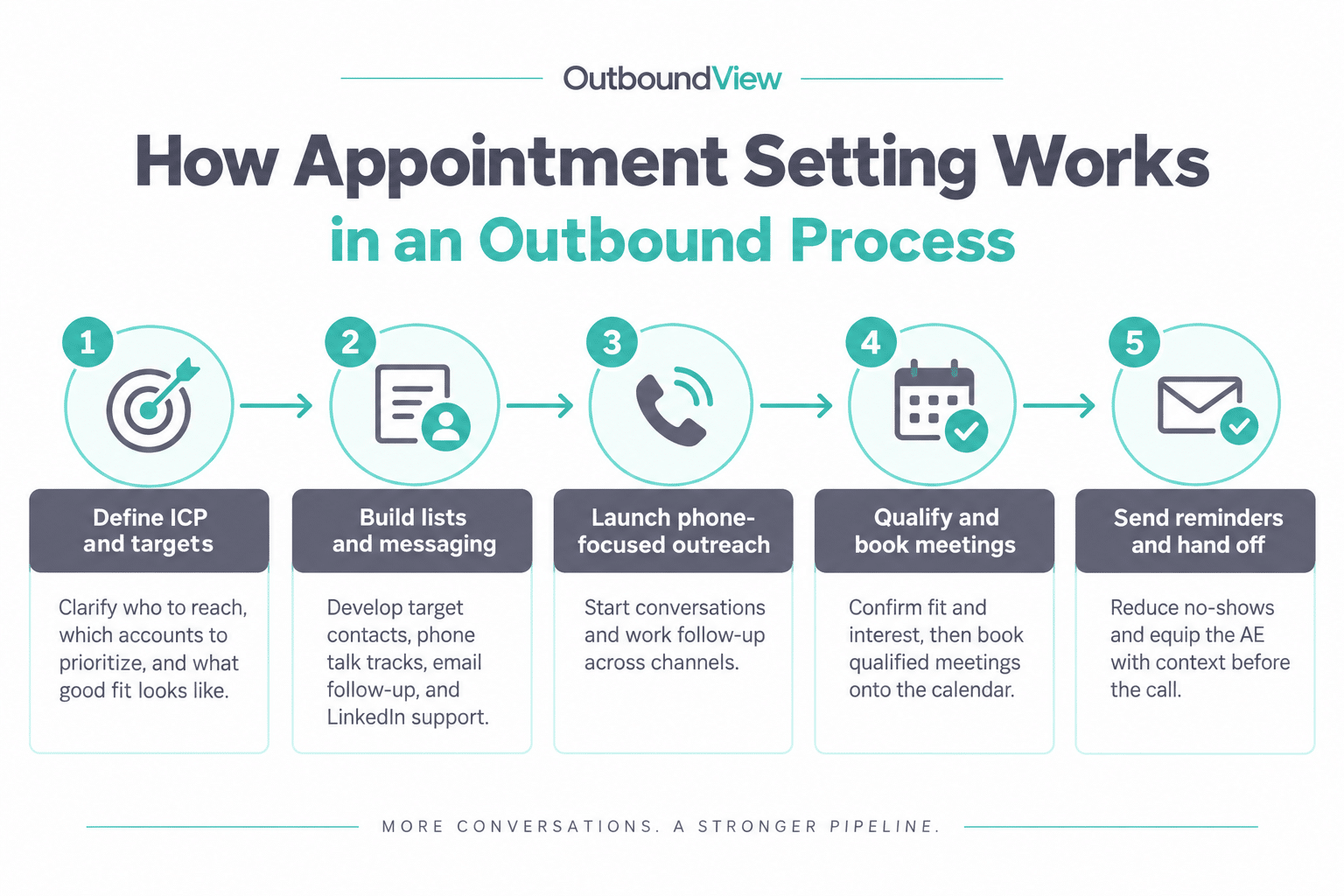
Strong appointment setting starts before the first call. The process depends on clear ICP definition, good target lists, relevant messaging, and a qualification standard your sales team trusts.
The handoff also matters. A booked meeting is only useful if the right prospect shows up with enough context for a productive conversation.
- Define the ICP and target account segments
- Build or refine contact lists and buying committee targets
- Develop phone, email, and LinkedIn messaging by segment
- Launch outbound outreach with phone at the center
- Qualify responses against agreed criteria
- Book meetings onto the calendar with clean notes
- Send reminders and reduce no-show risk
- Hand the meeting to the AE with context on account, pain, and conversation history
When Should a Business Hire an Appointment Setter?
Hire an appointment setter when your pipeline problem is really a prospecting capacity problem. If closers are spending too much time finding meetings instead of running them, or if marketing alone is not producing enough SQL volume, appointment setting can create needed top-of-funnel coverage.
This is usually a fit when the sales motion has clear buyer targeting and enough deal value to justify human outbound. Companies with a defined ICP, consultative sales process, and sales-led growth motion often benefit the most.
It is also a fit when leadership needs predictability. If the current pipeline depends on sporadic rep prospecting, founder hustle, or occasional inbound spikes, a dedicated appointment setting function can make activity and output more repeatable.
- Your account executives are prospecting instead of selling
- Pipeline coverage is inconsistent quarter to quarter
- You have a real ICP but not enough qualified meetings
- Your founder or sales leader is still doing outbound personally
- You need a faster route to market than hiring and ramping an internal SDR team
- You want transparent reporting on meetings booked, qualification quality, and pipeline contribution
When an Appointment Setter Is the Wrong Fix
Appointment setting will not solve a broken go-to-market foundation. If your offer is unclear, your ICP is too broad, or your sales process is not converting early conversations, adding more meetings can create more noise instead of more revenue.
It is also the wrong fix when expectations are off. If you expect one person to handle market strategy, data sourcing, messaging, dialing, emailing, LinkedIn, qualification, scheduling, reporting, and campaign optimization with no support, the role is being overloaded.
Buyers should separate lead quantity from meeting quality. More calendars filled does not automatically mean more pipeline if qualification standards are weak.
- You do not have a defined ICP or target market
- Your sales team cannot convert discovery calls into real opportunities
- Your average deal size does not support a human outbound motion
- You need strategic repositioning before adding outreach volume
- You are evaluating based only on cost per meeting without looking at quality and pipeline contribution
What Outcomes Should You Expect From Appointment Setting?
The right expectation is qualified meetings, not raw activity. Buyers should evaluate appointment setting based on whether the meetings fit the ICP, show up, convert into pipeline, and help the sales team focus on closing.
A good program also creates operational clarity. You should be able to see what is being worked, what messaging is resonating, where prospects are dropping off, and whether the campaign is producing enough sales conversations to support coverage goals.
That is why reporting matters. Without visibility into activity and outcomes, it becomes hard to separate targeting issues from messaging issues, rep execution issues, or sales handoff issues.
- Meetings booked onto the calendar
- Qualification rate
- Show rate
- Pipeline contribution
- Speed of follow-up and handoff quality
- Channel performance across phone, email, and LinkedIn
How Outsourced Appointment Setting Works
Outsourced appointment setting gives you a dedicated prospecting function without building it from scratch internally. Instead of hiring, training, managing, and ramping an individual rep or team yourself, you work with a partner that runs the outbound motion for you.
The best outsourced models go beyond scheduling. They include ICP work, list development, messaging, phone outreach, multi-channel follow-up, qualification, booked meetings, and reporting your leadership team can actually use.
For many B2B sales organizations, outsourcing is a build-vs-buy decision. If speed matters, internal management bandwidth is limited, or past SDR hiring has been uneven, outsourcing can be the cleaner route to qualified meetings and repeatable pipeline creation.
- Dedicated SDR coverage aligned to your ICP and sales motion
- Phone-focused outreach supported by email and LinkedIn
- US-based SDRs for live conversation quality and stronger buyer interaction
- Defined qualification and handoff standards
- Transparent campaign reporting and performance tracking
How to Evaluate an Appointment Setting Partner
If you are buying appointment setting, evaluate the operating model, not just the promise of more meetings. The right partner should be able to explain exactly how they target accounts, run outreach, qualify meetings, and report performance.
You also want alignment with your sales process. If the partner cannot define what a qualified meeting looks like in your environment, the calendar may fill up while pipeline quality falls.
- Do they understand your ICP and market segments?
- Is the outreach phone-focused or overly dependent on email automation?
- Who owns list building and target account quality?
- How do they define and enforce qualification?
- What does AE handoff look like before the meeting?
- What reporting do you receive on booked meetings and pipeline impact?
- Are they acting like a staffing solution or a managed outbound partner?
Appointment Setting Should Improve Pipeline Coverage, Not Just Calendar Activity
An appointment setter is valuable when the role is tied to real sales outcomes. The goal is not simply to put meetings on the calendar. The goal is to create qualified meetings that your team can turn into pipeline and revenue.
If your closers are carrying too much prospecting work, this is usually a capacity and process issue, not a motivation issue. A dedicated appointment setting function can help restore focus, improve top-of-funnel consistency, and make pipeline generation more repeatable.
If you are weighing build-vs-buy, look at speed, management bandwidth, and qualification discipline. The right outsourced model should give you more than activity. It should give you a phone-focused, accountable system for creating sales conversations with the right buyers.
If you want to see how a phone-focused, US-based SDR team can book qualified meetings onto your calendar, Schedule a Discovery Call.