

B2B lead generation services are worth considering when your team needs more qualified pipeline but cannot rely on reps to consistently prospect at the volume and quality required. The right provider should do more than generate names or activity. It should define your ICP, build clean target lists, run outbound across phone, email, and LinkedIn, qualify interest, and book qualified meetings onto the calendar with reporting you can tie back to pipeline.
If pipeline coverage is the problem, service model matters. Many companies buy lead generation because top-of-funnel output is inconsistent, reps are stretched thin, or growth targets moved faster than internal prospecting capacity. That does not mean every lead generation agency is a fit. Some vendors optimize for contact volume. Others optimize for booked meetings without enough qualification. The better B2B lead generation services are built around qualified pipeline, not vanity output.
Buyers should evaluate operating quality, not promises. If you are comparing providers, the real questions are practical: how they target accounts, how they source and maintain data, how they handle phone outreach, what counts as a qualified meeting, how they report performance, and whether the engagement can support a repeatable pipeline motion. Those are the areas that determine whether outsourced lead generation helps your sales team close more business or just manage more noise.
What B2B lead generation services actually include
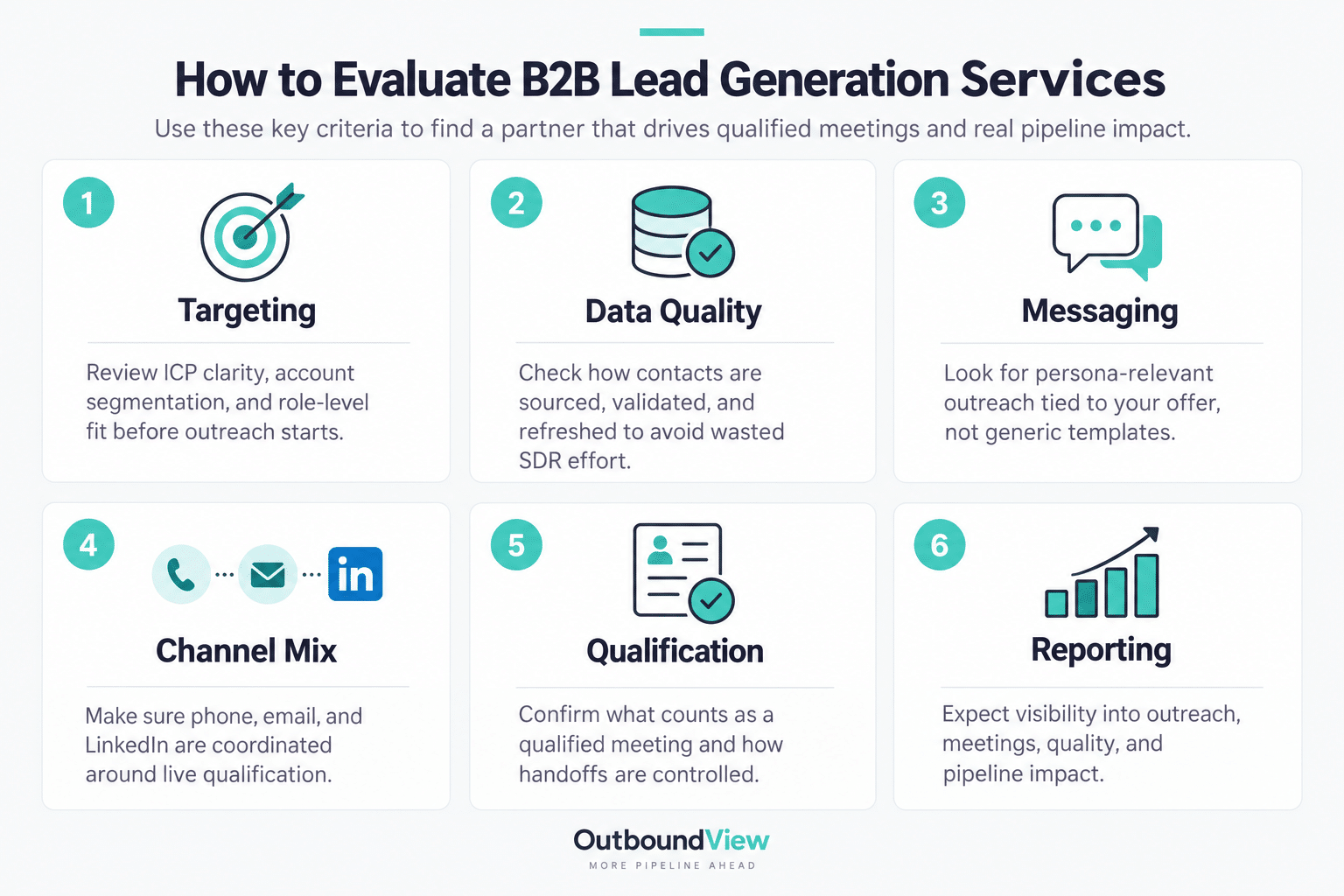
A real service should cover the work between strategy and sales conversation. Buyers often use the term broadly, but B2B lead generation services can mean very different things depending on the provider. At a minimum, the service should connect ideal customer profile research, list building, outbound execution, qualification, and meeting booking into one operating system.
The handoff standard is where quality shows up. A provider that simply sends over leads is not doing the same job as a provider that books qualified meetings onto the calendar for your account executives. If your goal is better pipeline coverage, the second model is typically closer to what sales leaders actually need.
- ICP definition and account targeting
- Custom target lists and contact research
- Outbound prospecting through phone, email, and LinkedIn
- Messaging aligned to offer, market, and buyer role
- Lead qualification before handoff
- Meetings booked onto the calendar
- Campaign reporting tied to outreach, meetings, and pipeline
How to evaluate b2b lead generation services
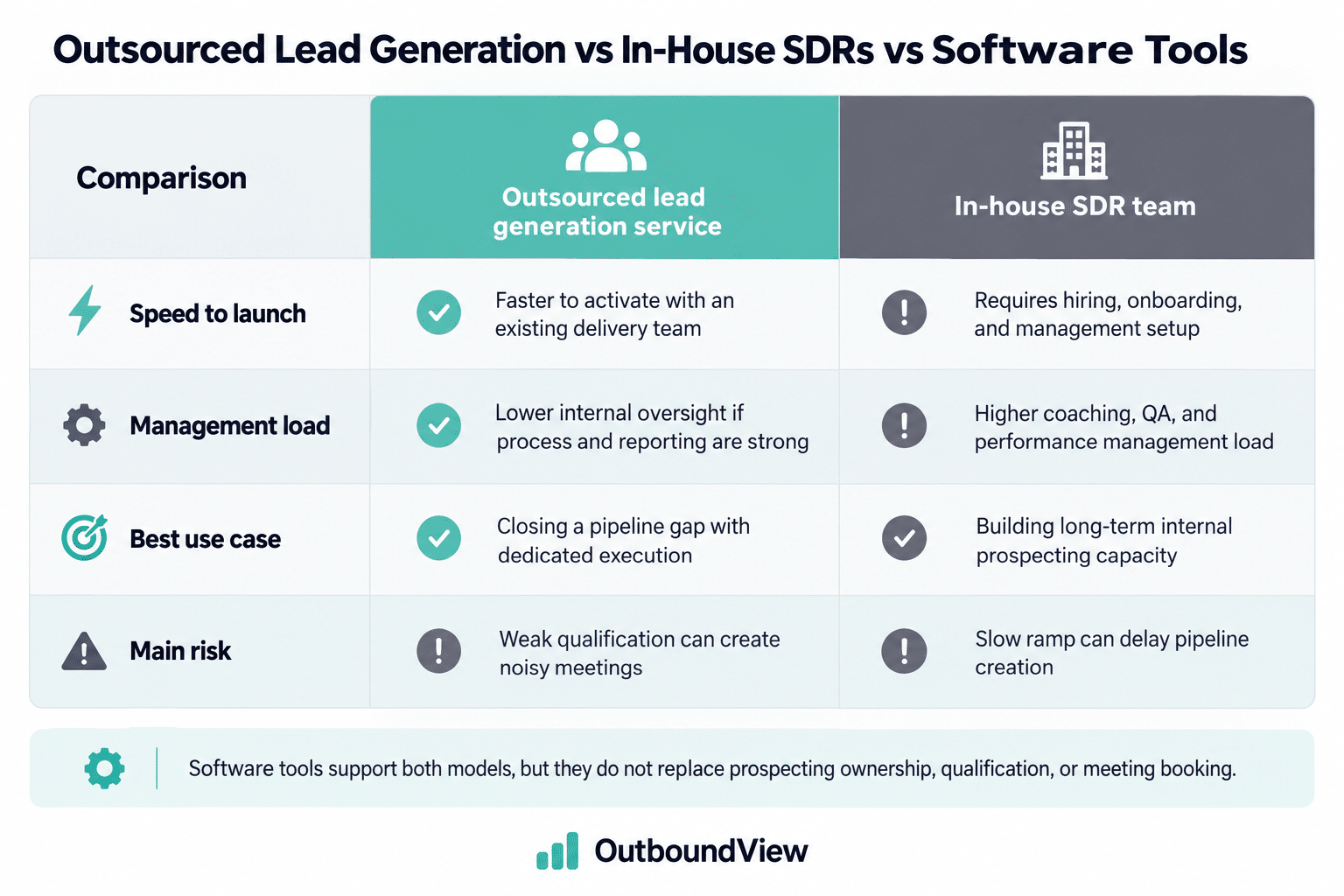
Most buyers compare providers too late in the process. By the time proposals show up, many teams are already reacting to pricing and promises. A better approach is to use a simple evaluation rubric before you shortlist vendors.
Start with targeting. If a provider cannot clearly explain how it narrows your market into a usable ICP, account segments, and contact tiers, the rest of the campaign will struggle. Lead generation quality starts with who gets contacted, not just how many people enter a sequence.
Then look at data quality. Contact accuracy, role relevance, and list freshness all affect connect rates, reply quality, and wasted SDR effort. Bad data creates false negatives and makes good messaging look weak.
Assess channel mix with a practical lens. For many B2B teams, phone remains the fastest path to live qualification and better meeting quality. Email and LinkedIn help support coverage and repetition, but they should work with the phone-focused motion rather than replace it.
Qualification standards need to be explicit. Ask what counts as a qualified meeting, who enforces the standard, and how disqualified meetings are reviewed. If the definition is vague, your calendar can fill up without improving conversion or pipeline.
Reporting should connect activity to revenue outcomes. You need visibility into outreach execution, meetings booked, show rates, qualification quality, and downstream pipeline impact. If reporting stops at opens, replies, or lead counts, it is not enough for a sales leader making a build-vs-buy decision.
- Targeting and ICP fit
- Data quality and list hygiene
- Messaging quality by persona and offer
- Channel mix, with clear phone strategy
- Qualification standards for booked meetings
- Transparent reporting and feedback loops
- Pipeline impact, not just top-of-funnel activity
What makes a lead generation service effective
Effective services remove friction for the sales team. The best outsourced lead generation does not create extra triage work for account executives. It delivers conversations worth taking, with enough context and qualification for the closer to move the deal forward.
Phone-first execution is often the difference between activity and access. In many B2B markets, inboxes are crowded and social outreach is easy to ignore. A phone-focused approach gives teams a better chance to validate interest, surface objections early, and confirm whether a meeting belongs on the calendar.
Dedicated execution matters more than broad capability claims. Buyers should understand who is actually running the outbound motion, how consistent the SDR team is, and whether they are trained to represent a complex offer credibly. Dedicated US-based SDRs are especially useful when calls require judgment, live qualification, and clear communication with senior buyers.
Feedback loops keep the campaign from drifting. Good providers review meeting quality, message performance, objection patterns, and account response by segment. Without that loop, campaigns keep producing activity even when quality is slipping.
- Clear qualification before handoff
- Phone-focused outreach for live conversations
- Dedicated SDR ownership rather than fragmented execution
- Tight coordination with sales on feedback and follow-up
- Continuous refinement of targeting, messaging, and list quality
Outsourced lead generation vs in-house SDRs vs software tools
This is a build-vs-buy decision before it is a vendor decision. Many teams do not need to choose one model forever, but they do need to choose the right model for their current stage, hiring capacity, and pipeline gap.
In-house teams offer control but require time and management. If you have strong sales development leadership, enough hiring bandwidth, and the runway to train reps, building internally can make sense. It is usually slower to launch and heavier to manage.
Software tools improve efficiency but do not replace execution. Data platforms, sequencing tools, and intent signals can support prospecting, but they still require targeting, messaging, calling discipline, qualification standards, and follow-up ownership.
Outsourced lead generation is often strongest when speed and repeatability matter. If leadership needs qualified meetings booked onto the calendar without waiting to recruit and ramp a full internal SDR function, outsourcing can close the gap faster while keeping reporting visible.
| Outsourced lead generation service | Teams that need faster pipeline support and dedicated execution | Quality varies widely if qualification and reporting are weak |
| In-house SDR team | Companies with time, management depth, and hiring capacity | Ramp time, recruiting effort, and ongoing coaching load |
| Software tools only | Teams that already have prospecting ownership and process discipline | Tools create leverage, but they do not create meetings by themselves |
Channels used in modern B2B lead generation
Channel strategy should follow buyer behavior and sales motion. There is no universal mix, but most effective B2B lead generation programs use multiple outbound channels in a coordinated way.
Phone should play a central role when qualification matters. Calling helps teams confirm relevance, reach decision-makers directly, and pressure-test whether the prospect belongs in your pipeline. It is especially useful when your sales team cares about meeting quality more than surface-level engagement.
Email supports timing and message repetition. It gives prospects a written reason to respond and a place to review value propositions after a call or voicemail. Its best use is usually as part of a sequence, not as a standalone channel.
LinkedIn can strengthen familiarity and coverage. It works well as a supporting touch for certain personas, especially when used to reinforce outreach rather than replace direct prospecting.
The key is orchestration. A provider should be able to explain how channels work together, when a prospect advances to qualification, and how outreach changes by segment.
- Phone for live access and qualification
- Email for follow-up and message reinforcement
- LinkedIn for visibility and supporting touches
- Sequenced outreach mapped to buying roles and account segments
Who should use outsourced B2B lead generation services
Outsourcing is most useful when the pipeline problem is clear. If your account executives are carrying prospecting they do not have time to do, if pipeline creation is uneven month to month, or if leadership needs faster top-of-funnel output without building a full SDR department first, outsourced lead generation is often the practical choice.
It also fits teams with a clear sales motion but inconsistent execution. Many companies know who they sell to and what a qualified opportunity looks like. What they lack is dedicated outbound capacity to turn that clarity into meetings booked onto the calendar.
The best fit is usually a company that values meeting quality. If your sales cycle is consultative, your ACV justifies human outreach, and your closers need relevant conversations rather than raw lead volume, outsourced SDR support tends to outperform list-and-lead models.
- VPs of Sales with a pipeline gap
- Teams where AEs are not prospecting consistently
- Organizations evaluating build-vs-buy for SDR capacity
- Companies that need predictable qualified meetings, not just more names
How OutboundView approaches B2B lead generation services
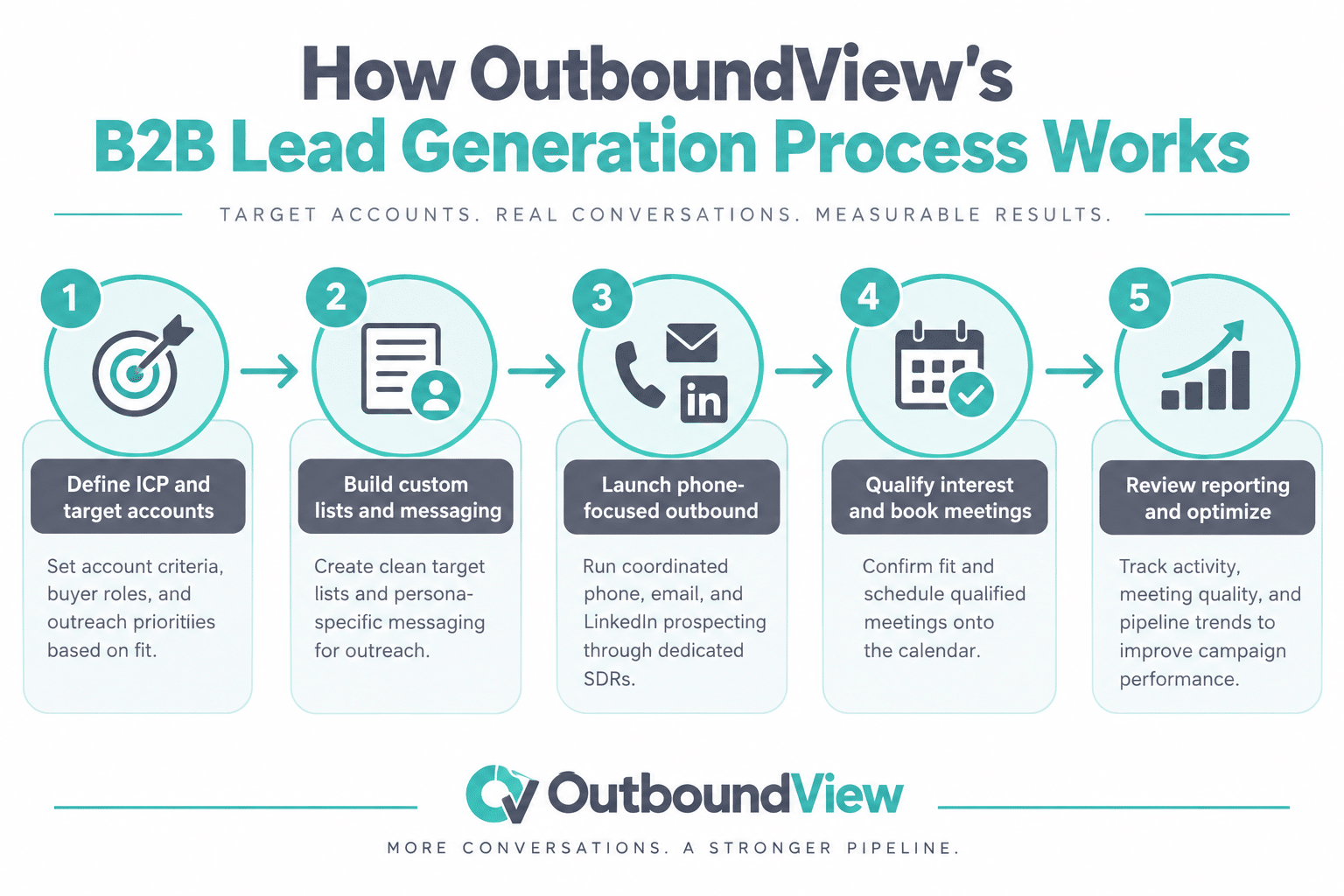
OutboundView is built around qualified pipeline, not broad activity. Our model uses dedicated US-based SDRs to run phone-focused outbound supported by email and LinkedIn. The goal is straightforward: book qualified meetings onto the calendar so your sales team can spend more time closing.
The work starts with target definition. We help shape ICP criteria, build custom target lists, and segment outreach so campaigns match your market and buyer roles. That reduces wasted activity and improves the quality of conversations that reach your closers.
Execution stays connected to qualification. Outreach is managed by a dedicated SDR team that is accountable for prospecting, conversation quality, and handoff standards. Meetings are not treated as equal by default; qualification matters.
Reporting is meant to support decision-making. You should be able to see what is happening in the campaign, how meeting quality is trending, and where feedback from sales should change targeting or messaging. That visibility is critical if you are comparing outsourced support against an internal team or trying to improve pipeline coverage quickly.
- Dedicated US-based SDR team
- Phone-focused outbound with email and LinkedIn support
- Custom ICP and target list development
- Qualified meetings booked onto the calendar
- Transparent reporting and campaign visibility
What to ask before you choose a lead generation agency
A shortlist becomes stronger when you ask operational questions. Most providers can speak confidently about outcomes. Fewer can explain the day-to-day mechanics that produce those outcomes.
Focus on how the work gets done. You want to know who is prospecting, how qualification is defined, how data is sourced, how channels are sequenced, and how feedback from your sales team changes the campaign over time.
This is also where poor-fit models get exposed. If a provider cannot explain meeting standards, reporting discipline, or how they handle underperforming segments, you are likely buying activity rather than pipeline generation.
- How do you define a qualified meeting?
- Who will actually run our outbound program day to day?
- How do you build and refresh target lists?
- What role does phone outreach play in your process?
- How do you report on meetings, quality, and pipeline impact?
- How do you adjust when a segment or message underperforms?
Choose B2B lead generation services based on pipeline quality
The right provider should make sales easier, not busier. If you are evaluating B2B lead generation services, look past lead counts and channel claims. The better question is whether the service can consistently deliver qualified meetings, support pipeline coverage, and show you what is working.
That usually comes down to operating discipline. Strong targeting, clean data, phone-focused outreach, clear qualification, and transparent reporting are what separate a useful engagement from a noisy one. If those pieces are in place, outsourced lead generation can become a repeatable source of pipeline instead of a temporary patch.
Schedule a Discovery Call