

Sales outsourcing services help B2B teams add consistent top-of-funnel execution without hiring and managing every outbound role internally. The most effective model is usually to outsource prospecting, qualification, and meetings booked onto the calendar while keeping closing with your internal sales team.
If pipeline coverage is slipping, sales outsourcing services can give you a faster way to rebuild outbound activity than hiring from scratch. For most B2B teams, the question is not whether prospecting matters. It is whether your reps have the time, process, and management support to do it consistently.
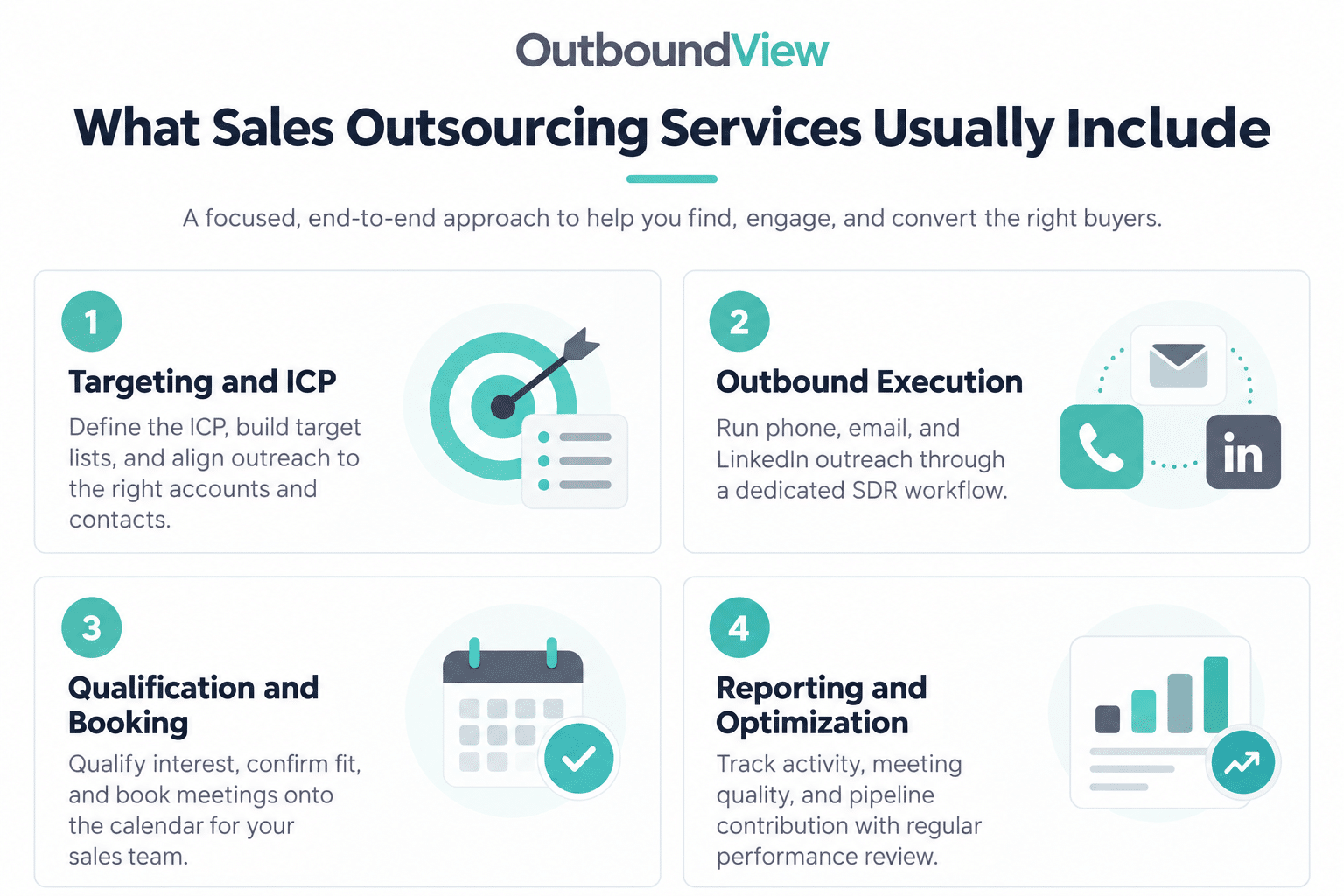
That is where sales outsourcing services fit. In practice, this can include ICP research, target list building, outbound messaging, phone outreach, email, LinkedIn touches, qualification, meetings booked onto the calendar, and campaign reporting. The right scope depends on what your team already does well and where execution is breaking down.
For most growth-stage sales teams, the best answer is a hybrid model: outsource outbound prospecting to a dedicated, phone-focused team and keep discovery, closing, and account ownership in-house. That gives you more qualified meetings without asking your closers to become full-time prospectors.
What sales outsourcing services include
Sales outsourcing services can cover very different functions, which is why buyers often compare apples to oranges. Some providers focus only on appointment setting. Others offer a broader B2B outbound program that supports list strategy, outreach execution, qualification, and reporting.
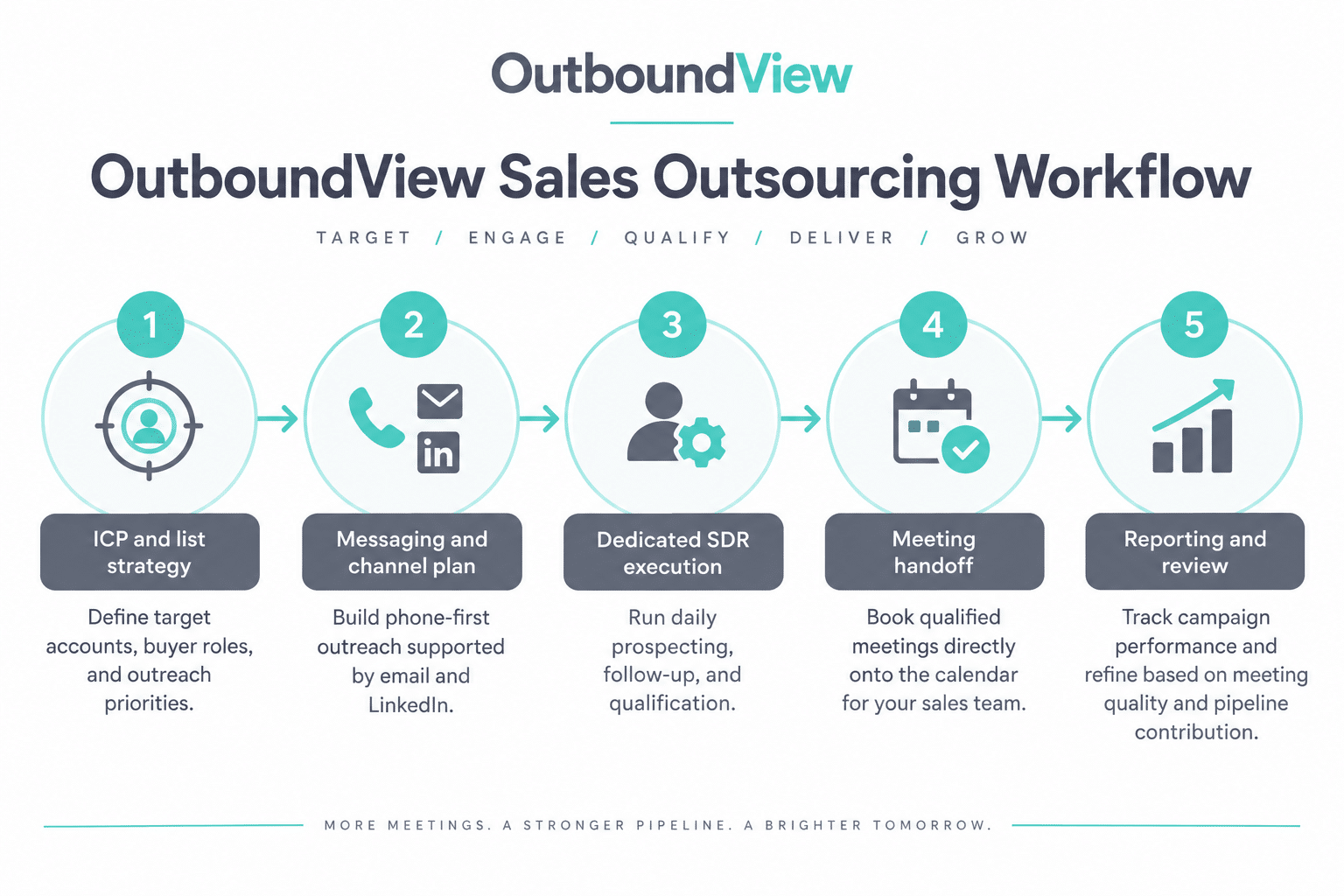
A useful way to evaluate scope is to look at the outbound workflow from target selection through booked meeting. If a provider only handles one small part of that chain, your internal team still has to manage the rest.
At OutboundView, the most valuable services usually sit in the prospecting layer of the funnel. That means building the right audience, reaching out consistently, qualifying responses, and delivering qualified meetings your sales team can work.
- ICP research and account targeting
- Custom target list building and contact sourcing
- Outbound messaging development
- Phone outreach by US-based SDRs
- Email and LinkedIn support within a multichannel sequence
- Lead qualification against agreed criteria
- Appointment setting and meetings booked onto the calendar
- Transparent reporting on activity, meetings, and pipeline contribution
Which parts of the sales process should you outsource?
Not every sales function should be outsourced. The strongest outcomes usually come when you outsource the parts of outbound that require daily execution and process discipline, then keep the parts that depend on product depth, deal strategy, and internal authority with your team.
Prospecting is the clearest outsourcing fit. It is labor-intensive, repetitive, and easy to deprioritize when account executives are chasing deals. A dedicated outbound team can protect activity levels, keep follow-up moving, and create more consistent top-of-funnel coverage.
Closing usually belongs in-house. Your internal sellers understand the product, pricing, buying process, and internal stakeholders better than an external team will. They are also accountable for conversion, forecast quality, and revenue outcomes.
There is also a middle ground. Some companies outsource only appointment setting. Others outsource a broader SDR function that includes messaging, outreach, follow-up, and qualification. The right model depends on whether your current bottleneck is list quality, outreach consistency, meeting volume, or conversion from first conversation to pipeline.
- Best to outsource: prospecting, SDR outreach, follow-up, appointment setting, early qualification
- Usually keep in-house: discovery, solution selling, proposal management, closing, account ownership
- Hybrid model works well when: your closers are strong but top-of-funnel execution is inconsistent
Our recommended model: outsource prospecting, keep closing in-house
For most B2B teams, this is the cleanest build-vs-buy decision. Outsource the work that creates conversations. Keep the work that converts those conversations into revenue.
Why this model works is straightforward. Prospecting needs focus, repetition, channel coordination, and manager oversight. Closing needs product fluency, buyer trust, and direct alignment with your sales process. Trying to force one role to do both often weakens both.
A dedicated outsourced SDR team can work as an extension of your sales function. They handle outreach, qualification, and meeting booking, while your AEs or sales leaders step in once a qualified buyer is ready for a real sales conversation.
This approach also improves accountability. You can evaluate prospecting performance on activity quality, conversation rates, qualified meetings, and pipeline creation, while your internal team remains responsible for sales process execution and close rates.
- More consistent outbound execution
- Less prospecting load on account executives
- Clear ownership between meeting creation and deal conversion
- Faster route to pipeline coverage than building every role internally
Sales outsourcing services vs in-house hiring
Most buyers are really making a build-vs-buy decision. They want to know whether it is smarter to hire, train, and manage an internal SDR function or to partner with an outside team that already has the process and management structure in place.
In-house hiring gives you control, but it also requires recruiting, onboarding, messaging development, list support, coaching, management cadence, and enough volume to justify the effort. If you need pipeline support now, internal buildout can feel slower and heavier than expected.
Outsourced sales support gives you execution leverage. A good provider brings a team, operating rhythm, and reporting model. That can reduce the management load on your sales leaders and help you move from strategy to live outreach faster.
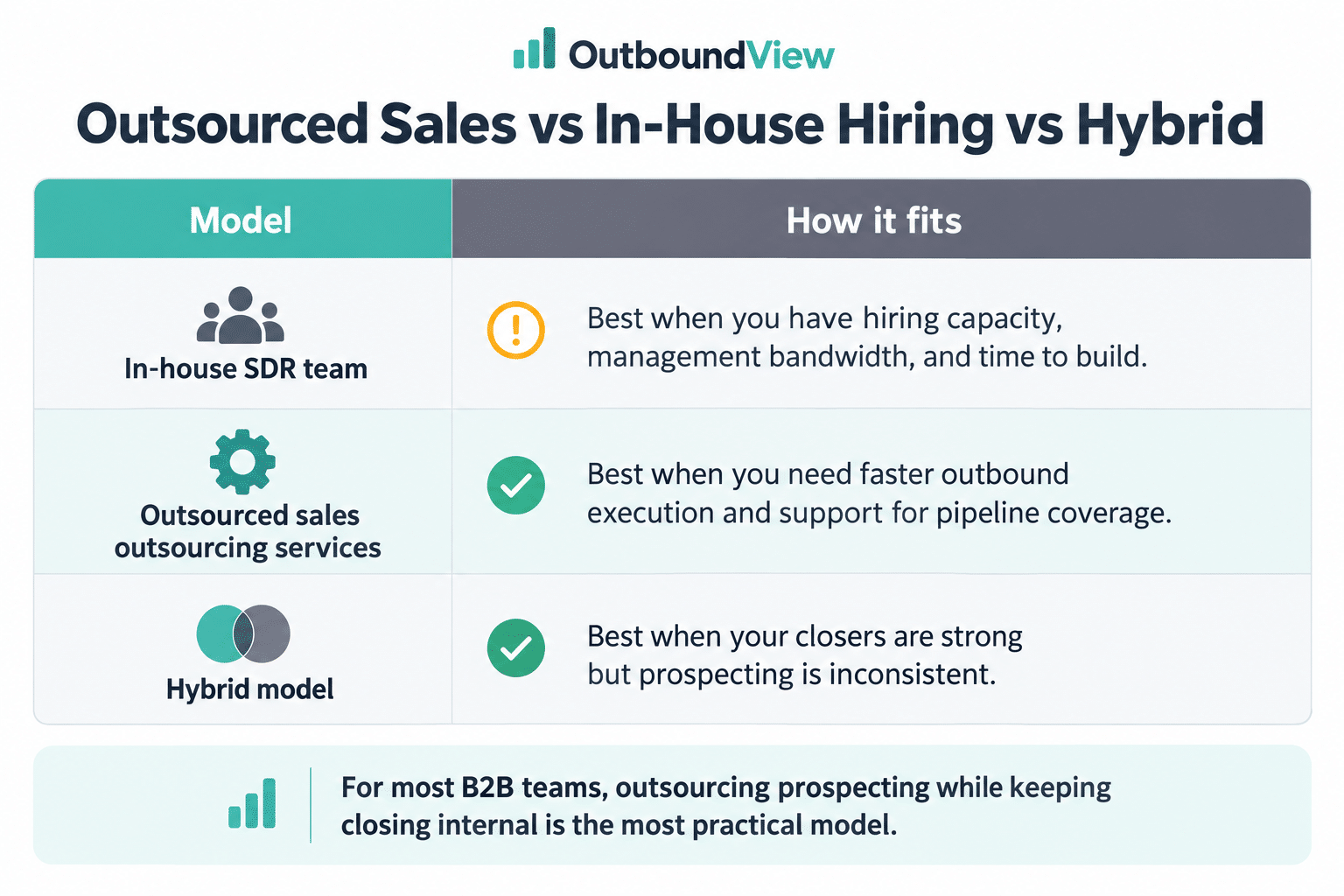
Hybrid is often the practical answer. Keep sales leadership, account executives, and closing internal. Use an outsourced SDR team for prospecting, appointment setting, and outbound consistency.
| In-house SDR team | Teams with time, leadership bandwidth, and a long-term hiring plan | More internal management, slower ramp, and added hiring risk |
| Outsourced sales outsourcing services | Teams that need faster outbound execution and clearer pipeline support | Requires strong alignment on ICP, messaging, qualification, and handoff |
| Hybrid model | Teams with strong closers but inconsistent top-of-funnel activity | Needs clear ownership between outsourced prospecting and internal sales follow-up |
How much do sales outsourcing services cost?
Cost depends on scope. A narrow appointment setting program will be priced differently than a broader outsourced SDR model that includes ICP work, list building, multichannel outreach, qualification, and reporting.
The better question is what you are comparing it against. If your alternative is doing nothing, outsourced sales may look expensive. If your alternative is hiring, onboarding, managing, and supporting internal prospectors, the comparison becomes more practical.
You should evaluate cost against four factors: internal hiring effort, speed to launch, management burden, and expected pipeline impact. Buyers often focus too much on monthly fees and too little on the hidden cost of delayed execution.
Ask providers to define scope clearly. You should understand who owns targeting, list quality, messaging, phone outreach, email setup, qualification standards, calendar booking, and reporting cadence before comparing price.
- Service scope by channel and function
- Whether the team is dedicated or shared
- How much strategy and management is included
- What reporting and optimization cadence you receive
- How qualification and handoff are defined
What good B2B sales outsourcing looks like in practice
The best providers do more than generate activity. They create a working outbound system with clear ownership, buyer targeting, channel execution, qualification rules, and reporting that your leadership team can actually use.
That system should start with ICP clarity. If the target market is too broad or the messaging is generic, no amount of SDR activity will solve the problem. Good outsourced sales programs tighten targeting before they increase volume.
Phone matters more than many vendors admit. Email and LinkedIn can support the sequence, but phone-focused outreach is what often separates passive activity from real conversations. For buyers evaluating B2B sales outsourcing, this is one of the most important service-level differences to look for.
Reporting should go beyond booked meetings. You need visibility into outreach quality, qualification consistency, meeting outcomes, and whether the program is contributing to pipeline coverage in a way your team can trust.
- Documented ICP and targeting criteria
- Message testing and sequence refinement
- Dedicated SDR execution, not sporadic outreach
- Clear qualification standards
- Reliable handoff process to your closers
- Regular reporting and performance review cadence
When sales outsourcing services are a bad fit
Sales outsourcing is not the answer to every growth problem. If your offer is unclear, your market is undefined, or your internal team does not follow up on meetings, outsourcing prospecting will not fix the root issue.
It is also a weak fit when buyers expect full-cycle selling by an outside team in a complex B2B environment. External teams can support top-of-funnel execution effectively, but most companies still need internal ownership for discovery, solution alignment, and deal progression.
You should be cautious if a provider is vague about process. If they cannot explain how they build lists, how they qualify, how they report, or how quickly they launch, you may end up buying activity without accountability.
- Poor fit: unclear ICP, weak offer positioning, no internal follow-up discipline
- Poor fit: expecting an outside team to replace your closers entirely
- Good fit: strong offer, capable sales team, and a clear need for more qualified meetings
How OutboundView approaches sales outsourcing services
OutboundView is built around B2B outbound execution. We help companies create more pipeline coverage through phone-focused prospecting, qualified meetings, and transparent campaign reporting.
Our model is designed for teams that want support where it matters most. We provide dedicated US-based SDRs who handle outreach across phone, email, and LinkedIn, backed by ICP research, target list development, qualification, and reporting.
We do not try to replace your closers. We help your internal sales team spend more time selling by taking prospecting, follow-up, and meeting creation off their plate. That is usually the most efficient line between outsourced support and internal revenue ownership.
If you are evaluating providers, start by comparing how each one handles targeting, phone execution, qualification, meeting standards, and reporting cadence. Those are the operational details that shape results more than a broad service label ever will.
Choose sales outsourcing services that match the actual bottleneck
The right sales outsourcing services solve a specific problem. For most B2B teams, that problem is not closing ability. It is inconsistent prospecting, weak outbound coverage, and too few qualified meetings reaching the calendar.
That is why the strongest model is usually hybrid. Keep closing in-house. Outsource the SDR work that drives conversations, protects activity levels, and supports more predictable pipeline creation.
If you want a practical next step, map your current gap first: targeting, outreach volume, qualification, handoff, or reporting. Once that is clear, it becomes much easier to decide whether you need appointment setting, a broader outsourced SDR function, or full-funnel lead generation support.
See how OutboundView helps B2B teams improve pipeline coverage with phone-focused prospecting and qualified meetings: /scale/